Jungles, rivers and untouched wilderness
Feel the rush of adrenaline as you explore Cambodia's most thrilling landscapes. This package is designed for those who believe holidays should be filled with excitement, new challenges, and the kind of experiences that make your heart race. Come home with incredible stories and unforgettable memories.
Discover the wonders of Cambodia, a captivating destination that offers unique experiences, rich culture, and memorable adventures. Whether you're seeking relaxation, adventure, or cultural immersion, Cambodia promises to exceed your expectations with its warm hospitality and stunning scenery.
10 nights in Cambodia — day by day, fact-checked
You land at Phnom Penh International, a short transfer from the centre, and the included driver takes you in. The only decisions are dinner and rest.
Phnom Penh International sits roughly 10km from the city centre, about 20 to 40 minutes by road depending on traffic. The operator meets you and drives you in, so decline any tout offering a transfer. Complete your e-Arrival Card before you fly, and keep your passport clean and complete for immigration.
Phnom Penh International Airport is roughly 10km from the city centre, about a 20 to 40 minute drive depending on traffic, and the transfer is provided by the operator on this package.
Check your arrival time before you fly. Your day starts whenever you land, so plan a light first evening rather than a fixed schedule, whether that is an early-morning or a late-night arrival.
Complete the free electronic e-Arrival Card within 7 days before you arrive, using only the official channel, and have your passport valid for at least 6 months and undamaged.
The US dollar is accepted everywhere and prices are quoted in dollars and riel. Carry small, clean US notes and some riel for meals beyond your hotel board basis, tips and small purchases; the package itself covers hotels and transfers.
Check any US dollar notes you receive as change are genuine and not torn, since fake bills circulate as change and damaged notes are often refused.
Do not hand over your passport as security for anything, including a moto or scooter rental. FCDO states you should never surrender it as a guarantee.
For an easy first meal, walk-in dining is the norm and there is no market-wide booking platform. Home-style Khmer food keeps the first night simple after a long flight. Carry small, clean dollar notes and riel, and check any change you are given.
There is no OpenTable-style national reservation system in Cambodia, and the tour operator arranges the meals that come with your excursions, so restaurant booking is walk-up rather than online.
For an independent hop, tuk-tuks are everywhere and ride-hailing apps operate; agree the route with the driver first and keep bags held in front of you.
Do not ride pillion on a moto-taxi. FCDO calls passenger motorbike travel dangerous due to poorly maintained vehicles and low driving standards, with added bag-snatching risk.
Cambodia's first fine-dining Khmer restaurant, a settled Phnom Penh institution for a proper Khmer first night; its official site is unreachable, so we name and locate it only.
Nom banh chok, grilled skewers and noodle soups are cheap and everyday across Phnom Penh, best taken as a guided or operator-arranged stop given variable hygiene and vendor turnover.
A sobering pairing of Tuol Sleng and the Killing Fields, the standard Phnom Penh history half-day, with a museum or riverside afternoon. All entry is operator-arranged.
Tuol Sleng, the former S-21 prison, is a hard but essential morning that explains the Khmer Rouge period. It opens every day, and on a guided package your entry is arranged, so there is no ticket to buy. The audio guide is optional; a human guide is not compulsory.
On this guided package the visit is operator-arranged. For reference, international adult admission is US$5, ages 10 to 17 US$3, under 10 free, cash only in riel or US dollars. The optional audio guide is US$5.
A human tour guide is not compulsory and works on a contribution basis; the audio guide runs in around 11 languages. Your package guide accompanies you regardless.
This is a memorial: dress and behave respectfully, keep voices low and follow any no-photography signs inside the rooms.
Carry clean small US dollar or riel notes for the entry and audio guide, which are cash only, in case you visit independently rather than as part of the group.
Do not treat this as a quick photo stop. It is a genocide museum; skipping the audio or human guide means missing the context that makes the visit meaningful.
The Choeung Ek memorial sits about 15km south of the city and is the standard afternoon pairing with Tuol Sleng. The operator includes it and drives you there. Its own site does not publish reliable hours or fees, so treat any figure as operator-confirmed.
Choeung Ek is about 15km south of Phnom Penh and is a standard half-day paired with Tuol Sleng; the operator arranges the transfer and entry.
Entry is operator-managed on this package, so you do not book it yourself. Its official site could not be reached, so hours and fees are confirmed by the operator.
Cover your shoulders and knees and behave respectfully; this is a working memorial, not a sightseeing attraction.
Bring water and sun cover for the walk between the memorial stupa and the grave sites; the middle of the day in Phnom Penh is hot and largely unshaded.
Do not stray off the marked walkways. Cambodia is heavily affected by landmines and unexploded weapons and mined areas are often unmarked, so stay on cleared routes.
After a heavy day, a contemporary Khmer dinner near the riverfront resets the mood. Meals are operator-arranged, so there is nothing to book. Keep bags cross-body and away from the road in the crowd, and check any change you are handed.
Tipping is customary but not obligatory; small amounts for guides, drivers and staff are the norm rather than a percentage.
Do not accept a torn or heavily marked US dollar note as change: it is often refused elsewhere, so ask for a clean replacement.
The Phnom Penh branch of Cambodia's most decorated Khmer restaurant, a contemporary Khmer tasting menu with French technique for a memorable city dinner.
A gentler city day around the Royal Palace and the National Museum's Khmer sculpture collection, useful groundwork before Angkor. Entry and transport are operator-arranged.
The Royal Palace complex and its Silver Pagoda are the morning's anchor. Because it is a royal and religious site, the dress code is strict and it can close without notice for royal events, so your guide confirms access on the day. Entry is operator-arranged.
Cover your shoulders and knees. FCDO's religious-site rule means you can be refused entry for shorts or skirts above the knee or bare shoulders, and the palace enforces this.
Hours and admission are operator-confirmed on the day; no official Royal Palace ticket page could be reached, and the palace can close without notice for royal events.
Ask permission before photographing people, especially monks, and follow any no-photo signs inside the pagoda; never photograph near military sites.
Wear slip-on shoes: you remove footwear at the Silver Pagoda and other sacred structures, so easy-off shoes save time.
Do not turn up in shorts assuming you can buy a cover-up at the gate. Refusal of entry is the enforcement mechanism, so dress correctly before you arrive.
The National Museum holds the world's foremost Khmer sculpture collection, including the seated Jayavarman VII, and is a strong 60 to 90 minute primer before Angkor. It opens daily with last tickets at 16:30. On this package entry is operator-arranged.
On this guided package entry is operator-arranged. For reference, foreign adult admission is US$10 per day and ages 10 to 17 US$5; under-10s and school groups are free.
Guided tours can be arranged at the entrance in Khmer, English, French or Japanese and are not compulsory; your package guide is with you regardless.
Allow 60 to 90 minutes. Seeing the Angkorian sculpture here first makes the temples at Siem Reap far more legible.
Arrive well before the 16:30 last-ticket cut-off if you visit independently, so you are not rushed through the sculpture galleries.
Do not skip the museum to save time for shopping. Without the sculpture context here, Bayon and Angkor Wat are much harder to read a few days later.
A final Phnom Penh dinner leans on Khmer fine dining before you move north. Meals are operator-arranged, so there is nothing for you to book. Carry small clean notes for tips and drinks, and check any change against fakes.
Reservations at named restaurants are operator-managed here; Cambodia has no national booking platform, so independent diners walk in or phone ahead.
Keep your bag cross-body and on the pavement side around the riverfront after dark; bag-snatching by riders on motorbikes is the main petty-theft risk.
Do not walk with your phone loose in your hand near the road; snatch thieves on motorbikes target exactly that.
Contemporary Khmer cuisine with French technique from the team behind the first Cambodian restaurant named to Asia's 50 Best, a fitting last Phnom Penh dinner.
A long-running Phnom Penh French fine-dining option if you want a change from Khmer; its official site is unreachable, so we name and locate it only.
A short domestic flight north to Siem Reap, the base for Angkor. The operator handles the flight and both airport transfers; the afternoon is light before the early temple starts.
The move to Siem Reap is normally a domestic flight of around 45 to 50 minutes, and the package's transfers cover it. Note the new Siem Reap-Angkor airport sits 40 to 50km east of town, so the drive from the runway to your hotel takes 60 to 90 minutes.
Phnom Penh to Siem Reap is normally a domestic flight of about 45 to 50 minutes; the alternative is a long 5 to 6 hour road transfer. The operator arranges whichever leg applies.
The new Siem Reap-Angkor International Airport is around 40 to 50km east of Siem Reap town, roughly 60 to 90 minutes by road; the old in-town airport is closed. These distance figures are indicative, not government-verified.
Angkor is front-loaded at dawn on the days ahead because the middle of the day is punishingly hot, so use this lighter arrival afternoon to rest before an early start.
Repack a temple-ready outfit near the top of your bag: knee-length bottoms and a shoulder-covering top for every Angkor day, since the dress code is enforced by refusal of entry.
Do not book your own onward domestic flight or transfer to save money. Both the flight and the long airport-to-town drive are already included and operator-scheduled.
For a first Siem Reap evening, Phare is an hour-long, non-animal circus run as a social enterprise, with ticket money supporting the arts school behind it. It is the ethical antidote to animal shows. Nightly shows start at 8:00pm at the red big top on Ring Road.
Nightly shows at 8:00pm, with seasonal 5:00pm matinees from November 2026 to March 2027.
Section A US$38 adult / US$18 child, Section B US$28 / US$15, Section C US$18 / US$10; every ticket supports Phare Ponleu Selpak, the school that trains the artists.
About an hour; a genuinely local, non-animal evening at the red big top on Ring Road near Sok San Road.
This is a social enterprise, so the money stays local; if your package does not already include it, it is one of the better independent bookings in Siem Reap.
Do not chase an animal show or elephant-ride product instead. Phare is the non-animal, ethical choice and keeps money with the arts school.
A non-animal social-enterprise circus whose ticket sales fund a Cambodian arts NGO for disadvantaged youth, the strongest ethical evening pick in Siem Reap.
The marquee Angkor day, front-loaded at dawn to beat the heat. Angkor Wat at sunrise, then Angkor Thom and the Bayon. Your pass and guide are operator-included.
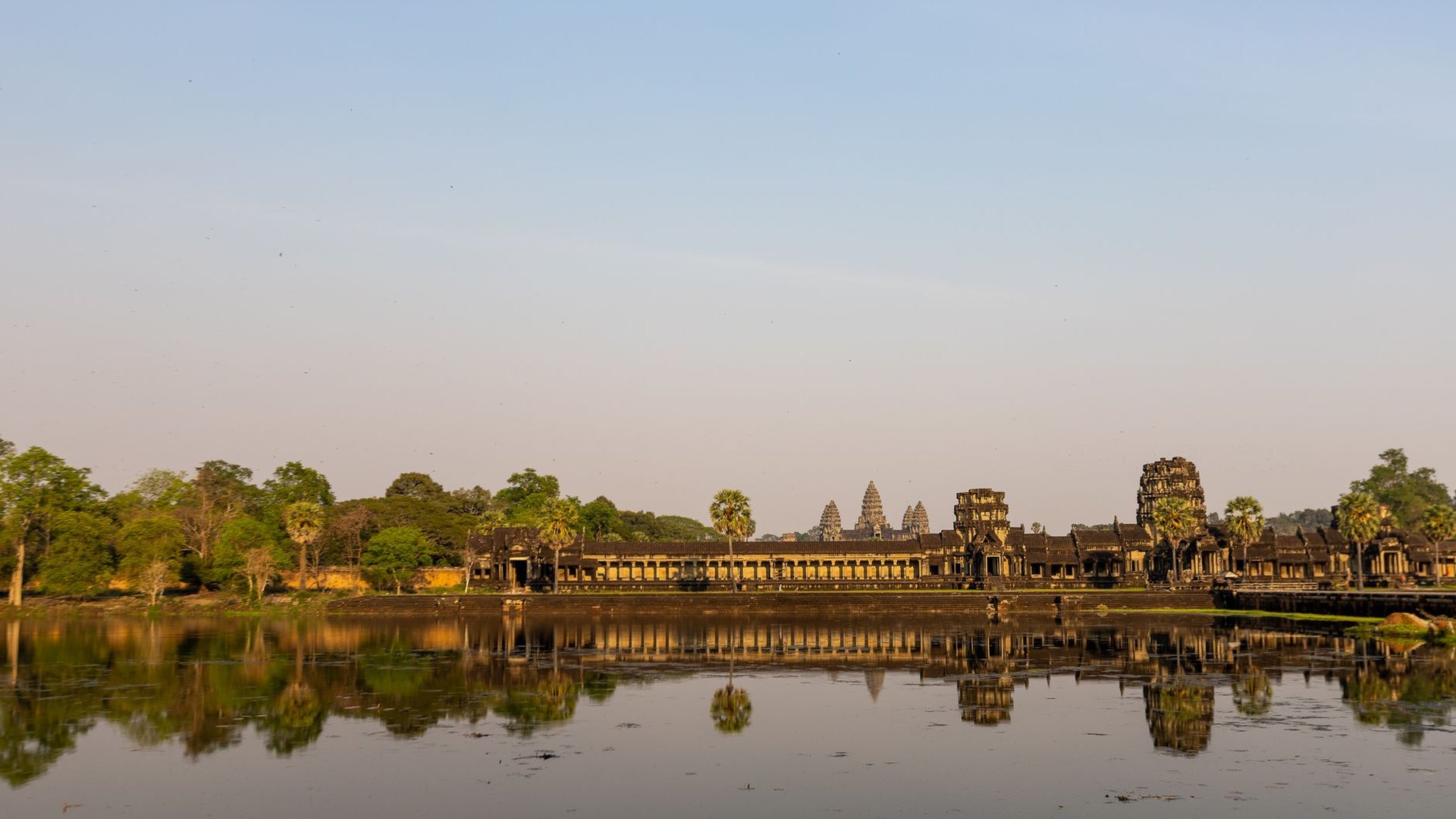
Angkor Wat at first light is the anchor of the whole trip, which is why the day starts in the dark. The park's pass and your guide are operator-included, so there is no ticket queue for you. Dress code is enforced at the central tower, so cover knees and shoulders.
Guided itineraries front-load Angkor at dawn because the middle of the day is punishingly hot; the ticket office opens very early for sunrise. Exact sunrise and opening times are indicative, not officially verified, and are confirmed by your guide.
The Angkor Archaeological Park pass and a licensed guide are included and operator-managed on this package, so you do not buy the pass or queue for tickets.
Cover your knees and shoulders. FCDO states you may be refused admission to Angkor Wat for skirts or shorts above the knee or bare shoulders, and it is checked before you climb the central tower.
A head torch or phone light for the pre-dawn approach, plus water and repellent; dengue and Japanese encephalitis mosquitoes bite by day and around dawn and dusk.
Ask permission before photographing monks or other religious figures, and never photograph near any military site.
Do not skip the dawn start to sleep in. By mid-morning the heat and crowds build fast, which is exactly why the itinerary puts the temples first.
After sunrise you move into the walled city of Angkor Thom and the Bayon, famous for its stone faces. Restoration works are ongoing at parts of Angkor, so some corners may be scaffolded. Your guide sets the pace to stay ahead of the midday heat.
Restoration work is ongoing across parts of the Angkor complex, so expect some scaffolding or partial works at individual temples during a 2026 visit.
Keep knees and shoulders covered all day; the dress code applies across the temple complex, not just at Angkor Wat.
Refill your water and reapply sun cover between temples; the day is governed by heat, and there is little shade on the causeways.
Do not climb on the sacred structures or strike disrespectful poses with Buddha images; behave respectfully as you would at any working religious site.
Do not rush every face-tower for photos and skip the guide's context. The Bayon's layout and history are the point, not just the selfie angle.
A second Angkor day for Ta Prohm's roots-and-stone ruin and the road out to Banteay Srei, with the Landmine Museum on the way. Pass and guide stay operator-included.
Ta Prohm, the tree-root temple made famous by Tomb Raider, is best early before the crowds. Its south gate is under active restoration, around three-quarters complete in mid-2026 and due to finish by year end, so expect scaffolding and partial works on site.
Ta Prohm's south gate is under an APSARA and Archaeological Survey of India restoration begun in early 2023, about 75% complete as of 15 June 2026 and due for completion by the end of 2026; expect scaffolding and partial works.
Go early. Ta Prohm is one of the most photographed temples and fills quickly once the sun is up, so the dawn slot is calmer and cooler.
Cover knees and shoulders as at every temple, and wear shoes with grip for the uneven root-and-rubble ground.
Stay on the marked timber walkways through the ruin; they route you around the collapsed sections and the active restoration zone.
Do not queue only for the single famous root-over-doorway photo. The temple's atmosphere is spread across several courtyards, and the crowd bunches at one spot.
On the road toward Banteay Srei sits the Landmine Museum, which sets the day's temples against the country's mine-clearance history. It is directly on the route with no detour, opens daily, and pairs naturally with the far-temple drive.
Open every day, 07:30 to 17:30.
Foreign adults US$7, children under 13 free, cash preferred; on this package the visit is operator-arranged so the fee may already be covered.
It sits directly on the road to Banteay Srei temple, so it fits a standard Angkor day-trip route with no detour and is reachable by tuk-tuk.
Self-guided audio tours run via QR codes; personal Khmer or English tours need 48 hours' notice and are not compulsory.
This museum makes the FCDO landmine warning concrete: it is why you stay on cleared paths around rural temples and never pick up metal objects.
Do not dismiss it as a minor roadside stop. It is the clearest context for the country's mine legacy and directly relevant to your countryside days.
A serious, on-route museum on the Banteay Srei road that grounds the country's mine-clearance history, run as a non-profit and easy to fold into an Angkor day.
Back in town, a seasonal Khmer tasting menu is the standout Siem Reap dinner. Meals are operator-arranged, so there is nothing to book. If you dine independently, this restaurant closes on Sundays, so plan around that.
Meals are operator-arranged on this package. Independently, Cambodia has no national booking platform, so you walk in or phone the restaurant directly.
Cuisine Wat Damnak scheduled a closure of 13 to 19 April 2026 for Khmer New Year, so if your trip falls near then, confirm it is open before relying on it.
Do not assume a fine-dining Khmer restaurant is open Sundays. Cuisine Wat Damnak is closed on Sundays, so a Sunday night needs a different plan.
Seasonal Cambodian gastronomy and the first Cambodian restaurant named to Asia's 50 Best, a tasting menu only, and the benchmark Siem Reap dinner.
Home-style Cambodian cooking with a well-known fish amok from owner-chef Kethana, opposite Pannasastra University; its site publishes no hours or prices, so we name and locate it only.
A lake day built around a community-owned floating village rather than the tourist-trap alternative, with the drive out counted into the schedule. Boats are operator-arranged.
For the Tonle Sap, the operator routes to a community-owned village around 50km from Siem Reap, roughly an hour or more each way, instead of the nearest and most commercialised one. This is the least touristy lake village, with profits going to a local school.
Kompong Khleang is about 50 to 55km from Siem Reap, roughly an hour or a little over 1.5 hours outbound with stops; the operator schedules the drive and boat.
The community group tour departs Siem Reap at 2:00pm daily and runs about 5.5 hours all-in, including boat tickets and entrance fees.
On this package the boat is operator-arranged. For reference the community tour is listed at US$38.50 per person all-inclusive on the homepage and US$35 (US$25 under 12) on the FAQ, so re-confirm the current rate.
This operator is ChildSafe-certified and donates profits to the Bridge of Life School, with staff from the village, which is why it is the honest choice over the nearest village.
Do not accept a switch to Chong Kneas, the closest floating village. It is heavily commercialised and repeatedly reported for overcharged boats and a rice-donation scam, so choose the community village instead.
A community-owned, ChildSafe-certified lake tour whose profits fund a village school, and the least touristy floating-village choice over Chong Kneas.
Back in Siem Reap, a farm-to-table Khmer kitchen a few kilometres from the centre closes the lake day. Reservations are required and it sits outside the tourist core, so meals here are operator-arranged with transfer time built in.
Reservations are required at Lum Orng, which sits about 4.5km from central Siem Reap, so build transfer time in; on this package meals and transport are operator-arranged.
If you dine independently on a Tonle Sap day, refuse any overloaded or poorly maintained boat, and any that sails despite a weather warning; accidents have happened when boats are overloaded.
Do not treat a rural, reservation-only restaurant as a walk-in. Lum Orng requires a booking and is well outside the centre, so turning up cold risks no table.
A farm-to-table, New Mekong Cuisine kitchen from owner-chef Sothea Seng, a short drive from the centre and a strong reservation-only Siem Reap dinner.
A countryside leg to Battambang, well clear of the Thai-border zone, for its old-town streets and a social-enterprise lunch. The long drive is operator-scheduled.
Battambang is a slower countryside town reached by an operator-scheduled drive. It sits away from the Thai-border no-go zone, so it is clear of the FCDO advisory. Lunch at a Khmer social enterprise puts a share of profits into child-protection work.
The drive to Battambang is a multi-hour operator-scheduled leg; you are driven by a private vehicle and driver, not self-driving, given the high road-accident rate.
Battambang is a central-western town but is not in the FCDO 20km Thai-border zone; confirm no add-on strays toward the border, where crossings are suspended and landmines are present.
Jaan Bai, a Khmer social enterprise by Psar Nat, sends 51% of profits to the Cambodian Children's Trust and trains local youth, so it is a lunch that does some good.
Do not book the out-of-town bamboo train expecting authentic transport. It now runs as a short managed tourist ride on a purpose-built track, of debatable value; this status is from travel guides, not an official source.
A social-enterprise Khmer restaurant where 51% of profits fund the Cambodian Children's Trust's child-protection work, with dishes developed alongside noted regional chefs.
The countryside stay leans on an eco-lodge and quiet rural roads. This is where the landmine warning matters most: stay on cleared paths, follow your guide, and do not pick up metal objects. The middle of the day is hot, so pace activity around it.
Repellent and covering clothes for dusk; Japanese encephalitis risk peaks in the rural months and mosquitoes bite dusk to dawn, so bite avoidance matters more out here.
Rural roads and boat conditions are rougher in the wet season, when heavy rain falls several days a week; season month-boundaries are indicative, not government-verified, so pack a light waterproof either way.
Do not wander off the lodge's marked tracks for a photo. Mined areas are often unmarked, so stay on cleared routes and do not pick up metal objects.
A countryside day that faces the wildlife-tourism trap head-on: observation-only sanctuaries and no-chase dolphin viewing over rides and shows. Any far leg is operator-scheduled.
If your countryside leg reaches an animal encounter, the ethical rule is observation only. Cambodia's original elephant sanctuary in Mondulkiri is a no-rides, no-tricks project, but it is far to the east and an overnight commitment, not a day-trip, so the operator schedules it.
The Elephant Valley Project in Mondulkiri is an observation-only sanctuary, no rides, tricks, feeding or swimming. Mondulkiri is around 359 to 370km and 5 to 7 hours east of Phnom Penh, an overnight leg, and lies far from the Thai border.
Skip any elephant-ride product. The ethical option is an observation-only sanctuary; riding is the thing to avoid.
Mondulkiri sits on the Vietnam side of the country, well clear of the FCDO 20km Thai-border zone, so an eastern countryside leg does not raise the border-advisory problem.
Do not expect a far eastern sanctuary as a day-trip from Phnom Penh. At 5 to 7 hours each way it only works as a scheduled overnight, not a casual excursion.
Cambodia's original observation-only elephant sanctuary, with a no-rides, no-tricks policy, the correct elephant option if your itinerary reaches Mondulkiri; no day-tour price is published, so we name and locate it only.
If the route touches the Mekong at Kratie, the Irrawaddy dolphin is critically endangered, with fewer than around 85 thought to remain. Responsible boats glide quietly and cut engines rather than chase, so frame this as conservation viewing, not a guaranteed dolphin show.
Kampi, about 15km north of Kratie, is the dolphin-viewing pool; Kratie is roughly 228km and 3h45 from Phnom Penh, a long operator-scheduled leg, not a casual day-trip. Population and drive figures are indicative from travel guides.
Only use a boat that keeps its distance and cuts its engine near the animals. The Mekong Irrawaddy dolphin is critically endangered, so responsible operators do not chase or disturb them.
Treat it as conservation viewing rather than a show; sightings are not guaranteed, which is the honest expectation for a critically endangered wild population.
Do not push a driver to get closer for a photo. Any operator willing to chase the dolphins is the wrong one; refuse it and frame the trip as distant, quiet viewing.
The countryside leg returns you toward Siem Reap for a lighter final full day: an unhurried temple or town morning and a last proper Khmer dinner. Transfers are operator-arranged.
The final full day is deliberately lighter after the long countryside drives. A late-morning temple or town circuit avoids the worst heat, and your pass and guide are still operator-included. Keep knees and shoulders covered for any temple stop.
Keep the pace easy and beat the midday heat, which governs the day; a mid-morning temple or town loop is gentler than a full dawn programme after several travel days.
If you visit any temple today, cover knees and shoulders; refusal of entry is the enforcement, so the dress code applies to the very last temple as much as the first.
Use today to change any large or slightly worn US notes for clean small ones before departure, since torn notes are often refused for last-day tips and buys.
Do not book a punishing full-day dawn tour for your last full day. Several countryside travel days in, the heat and fatigue make a lighter loop the smarter call.
For a last night, a fusion Khmer kitchen inspired by 1960s Cambodia is a good change from tasting menus. Meals are operator-arranged, so nothing needs booking. Its posted hours online are garbled, so treat any time you see as unreliable.
Meals are operator-arranged. Independently, Cambodia has no national booking platform, so you walk in or phone; Pou's own online hours are visibly corrupted and unreliable.
Keep a small stash of clean US dollar notes and riel for final tips to your guide and driver; tipping is customary but not obligatory.
Do not rely on a restaurant's posted opening hours you find online for this one; Pou's listed times are typo-corrupted, so confirm directly before turning up.
Fusion Khmer cooking inspired by 1960s Cambodia from a Siem Reap-born chef, near Wat Bo Street; its published hours are visibly corrupted, so we name and locate it only.
Home-style Cambodian cooking with a signature fish amok from owner-chef Kethana, a reliable last-night Khmer option opposite Pannasastra University.
A final morning, then the operator drives you to the airport. Because the Siem Reap-Angkor airport is 40 to 50km east of town, the transfer is over an hour, so it is built into your departure.
The new Siem Reap-Angkor airport sits 40 to 50km east of town, a 60 to 90 minute drive, so the operator counts the transfer back from your check-in and collects you accordingly. Keep your passport clean and complete, and repack any temple-cover clothes.
The Siem Reap-Angkor International Airport is around 40 to 50km east of Siem Reap town, roughly 60 to 90 minutes by road via the expressway; the operator provides the departure transfer. These figures are indicative, not government-verified.
Count back from your departure. Because the airport drive is over an hour, the operator sets your pick-up from your check-in time, whether that is an early-morning or a late-night departure.
Have your passport valid for at least 6 months and undamaged for check-in, and keep it on you rather than in checked luggage.
Spend down small riel before you go, since it is harder to change back home; keep a few clean US dollars for any airport tip or purchase.
Do not underestimate the airport distance. This is not the old in-town airport; the 40 to 50km drive is why the transfer is scheduled with real margin.
Practical details verified 21 July 2026. Prices and opening hours change — we re-check them monthly, but confirm anything critical before you travel.
Real-time hotel prices for Phnom Penh, Siem Reap and Battambang. Upgrades are shown over each location's included hotel.
Select your preferred hotel tier above. Prices vary by hotel category.
We don't yet have confirmed facility details for this property, and we'd rather tell you that than guess. Call us on 0208 944 4514 and we'll confirm exactly what this hotel offers before you book.
Select your preferred airline and cabin

Tell us what you're dreaming of — the sun, the vibe, the budget — and we'll tailor it around you and call you back. No queues, no bots, and no pressure.
Pop in your details and pick a time — an advisor calls you back, usually within the hour.
Prefer to plan it properly? Book a focused 15-minute call with a destination specialist.