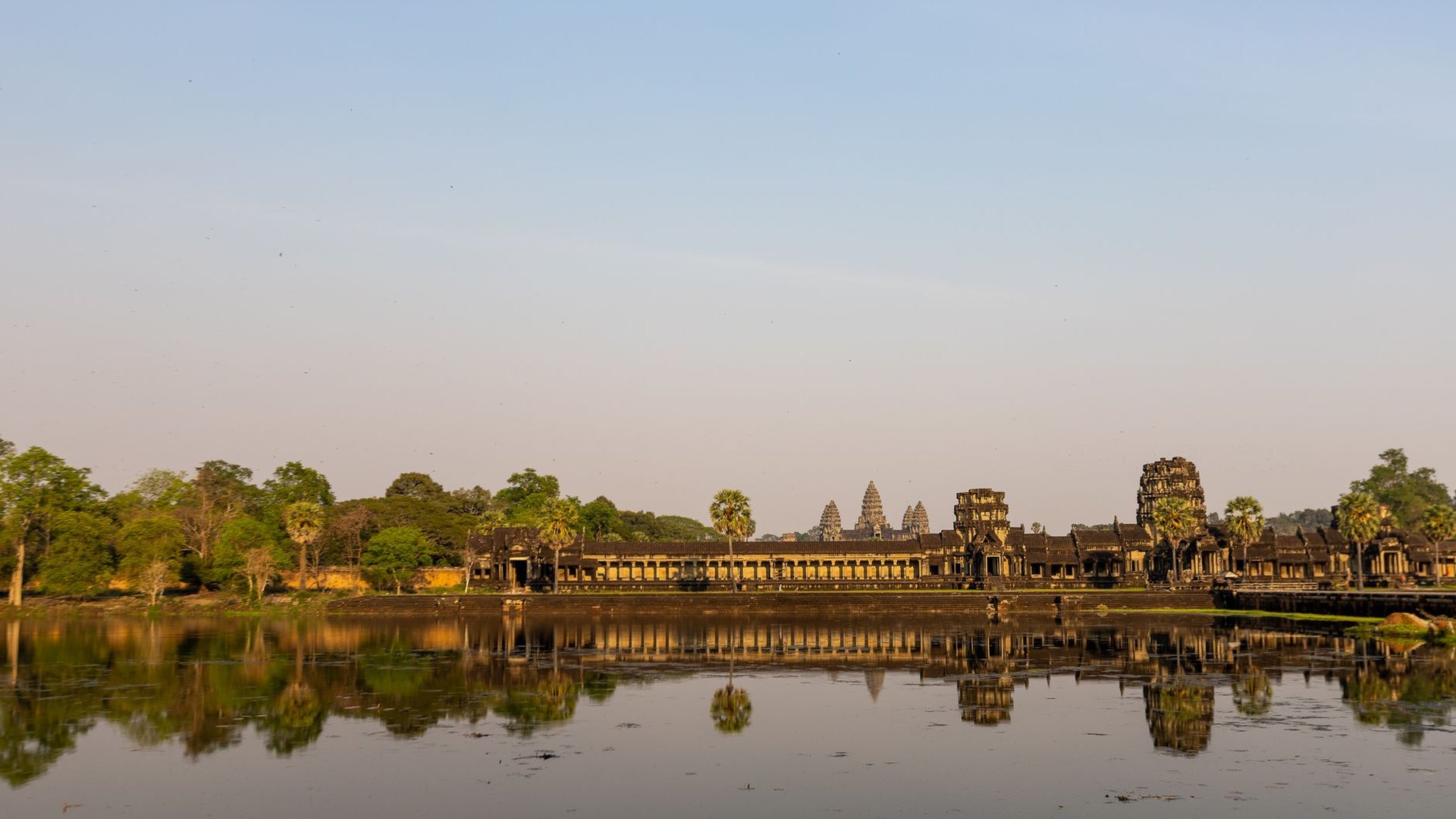
Lost temples rising from ancient jungle
This isn't just sightseeing — it's a journey into the heart of Cambodia's rich heritage. Walk through centuries of history, taste authentic flavors passed down through generations, and connect with traditions that have shaped this remarkable destination. Every moment becomes a story to tell.
Discover the wonders of Cambodia, a captivating destination that offers unique experiences, rich culture, and memorable adventures. Whether you're seeking relaxation, adventure, or cultural immersion, Cambodia promises to exceed your expectations with its warm hospitality and stunning scenery.
7 nights in Cambodia — day by day, fact-checked
Land at Siem Reap-Angkor International Airport, transfer to your 4-star hotel with the included driver, and settle in ahead of an early temple start.
Your flight lands at Siem Reap-Angkor International (SAI), about 50km east of town. The included guided transfer drives you the roughly 45 to 75 minutes to your hotel, so you do not arrange transport. Cambodia has one of the highest road-accident rates in south-east Asia, and dark driving raises the risk, which is why a driver handles this leg.
Commercial flights land at Siem Reap-Angkor International (SAI), about 50km east of town and 40km from Angkor Wat. The old REP airport closed to commercial flights on 15 October 2023.
The airport transfer runs roughly 45 to 75 minutes by road. This figure is widely reported but not officially sourced, so treat it as approximate.
Your package includes the guided transfer, so you are driven the ~50km rather than left to arrange it. FCDO notes Cambodia has one of the highest road-accident rates in south-east Asia and that travel after dark sharply raises risk.
Carry clean, undamaged US dollars from the airport. FCDO warns counterfeit dollar bills circulate as change, so check notes are genuine and not torn.
Do not skip the free e-Arrival Card thinking you fill it in on landing. It must be submitted within 7 days before arrival via the official free channel, and scam sites charge for it.
Whether an early-morning or a late-night arrival, your onward temple days are pre-arranged and guide-led, so the day of landing is only the transfer and check-in.
Once settled, a short tuk-tuk or hotel-driver ride reaches central Siem Reap for dinner. If your arrival is late, eat near the hotel and rest for the pre-dawn temple start. Sunset in Siem Reap sits at roughly 18:35 and barely shifts across the year. Wear bags cross-body, as motorbike bag-snatching is reported in tourist areas.
Sunset in Siem Reap is around 18:35 and, near the tropics, barely changes across the year (roughly 5:35 to 6:35 PM). This is medium-confidence and approximate.
Around town the tuk-tuk is the main independent transport; for larger prices US dollars are used and riel gives small change. Keep clean USD for tuk-tuks, tips and small vendors.
Do not accept an unmetered street tuk-tuk without agreeing the price first. Use your hotel or guide's driver, or a ride-hailing app, to avoid fare disputes.
FCDO reports most theft is bag-snatching by thieves on motorbikes in tourist areas, who cut straps and grab bags from people on foot or in tuk-tuks. Wear bags cross-body, away from the road.
Central Cambodian restaurant near Pub Street, effectively open through the day, named for fish amok, Cambodia's signature steamed-curry dish. A convenient first-night meal.
Inexpensive, casual, generous-portion Khmer eatery: the honest local option near the tourist centre, walkable from most central hotels.
A pre-dawn start for the Angkor Wat sunrise reveal, then the faces of Bayon inside Angkor Thom, with your licensed guide.
Your guide collects you before dawn for the Angkor Wat reveal. The northern reflecting pool draws 3,000 to 5,000 people for one photo in peak season, and many find that scramble underwhelming. Ask your guide to stand at the south reflecting pool, Srah Srang, or Pre Rup instead. The pre-dawn start is still worth it for the temple itself.
Angkor Wat gates open at 5:00 AM; sunrise runs roughly 5:30 AM in June to about 6:20 AM in January. Your guide handles timing.
Tell your guide you want to stand before the moat or at an alternative spot such as the south reflecting pool, Srah Srang, or Pre Rup (~5km east), which gets far fewer sunrise visitors.
Do not join the main northern-pool scramble by default. On a normal peak morning 3,000 to 5,000 people crowd it for the same photo, and many travellers find it far from magical.
Cover knees and shoulders. FCDO says you may be refused admission, including to Angkor Wat's upper level, for skirts or shorts above the knee or bare shoulders.
Angkor Wat's upper Bakan level is closed from 1:00 PM on the 14th and 28th of each month for conservation. If you want the top level, avoid those afternoons.
After Angkor Wat, your guide continues to Bayon inside the walled city of Angkor Thom, known for its stone faces. A long-term Japanese-supported conservation programme continues but does not close the temple in 2026. The included licensed guide adds historical context and navigates a huge site: a value-add, not a legal requirement, since guides are not compulsory here.
Bring water and sun cover; midday is intensely hot. Sensible touring is early-morning and late-afternoon with a midday break.
Your temple pass is included and handled by the guide, and the multi-day pass can be spread across the week, so pace temple days around the heat rather than rushing.
Do not treat the guide as optional overhead. Guides are not legally required at Angkor, but the licensed guide included in your package adds context and navigates a vast site.
Ask permission before photographing people, especially monks and religious figures, and never photograph military sites.
Back in town, a sit-down Cambodian dinner suits a long temple day. Higher-end venues can be booked by your hotel concierge; walk-in is the norm elsewhere. Carry clean US dollars for the meal and tips.
There is no single dominant local reservation platform. Walk-in is the norm; for higher-end places the hotel concierge or a phone/WhatsApp call is the way to book.
Cuisine Wat Damnak needs a reservation at least 24 hours ahead and is closed Sunday, so have the concierge book it early in your stay.
Do not assume cards are taken everywhere. Cards and QR work in town hotels and restaurants, but carry clean USD cash for smaller venues and tips.
Tipping is customary but discretionary for guides, drivers and staff, with no official rate. Inspect any dollar change for counterfeits.
Upmarket sit-down Cambodian cuisine using French technique, ideal for an evening dinner with a hotel-arranged transfer.
Authentic Cambodian cooking in a converted wooden Khmer house with garden seating, open seven days for a comfortable sit-down meal.
The tree-root temple of Ta Prohm before the coach crowds, then a lighter afternoon with a midday heat break.
Your guide starts early at Ta Prohm, the 'Tomb Raider' temple, where trees grow through the stone. Long-running stabilisation by the Archaeological Survey of India continues, with raised walkways installed, but the iconic tree-root doorway stays accessible. It is one of the most-visited temples, so arriving before about 10:00 AM beats the heat and the coach crowds.
Arrive early — the local guide recommends about 6:00 AM — to beat the tour buses that arrive around 9:00 AM and to catch golden morning light filtering through the jungle canopy.
Ta Prohm is open and stabilisation works added raised wooden walkways and handrails, so wear shoes with grip for uneven, sometimes damp stone.
Do not arrive mid-morning expecting a clear shot of the tree-root doorway. It is one of the busiest temples and the doorway rarely has no queue in peak season.
Knees and shoulders covered again today; the dress rule is enforced at entry across the religious sites.
Midday at Angkor is intensely hot. Your day is governed by temple hours and heat, not a siesta, so take a hotel break or a shaded lunch through the hottest hours before touring resumes late afternoon. Your included multi-day pass lets temple visits spread across the week without pressure.
Midday is intensely hot; sensible touring is early-morning and late-afternoon with a midday break. The day is governed by temple hours and heat.
Your temple pass has a fixed validity window and multi-day visits can be spread across the week, so there is no need to cram temples into the hot hours.
Book restaurants through their current official site or your hotel; some older Siem Reap restaurant web addresses have lapsed and now redirect elsewhere, so do not trust a stale link from an old blog or search result.
Bring water, sun protection and insect repellent. Dengue and chikungunya carry a year-round risk, so use daytime bite avoidance.
Not-for-profit training restaurant of the SPOONS Cambodia Organization, where disadvantaged young adults learn hospitality and profits fund the programme. Creative, authentic Cambodian food all day.
Friends-International training restaurant serving creative Cambodian food in a timber house with garden seating: a feel-good lunch that supports young people.
An evening show in town needs no long transfer, unlike a temple day. Phare, The Cambodian Circus runs an 8:00pm performance nightly year-round, about 10 to 15 minutes from most 4-star hotels. Performers are graduates of the Phare Ponleu Selpak arts NGO, making this an ethical, socially positive choice.
Phare's main show is 8:00pm nightly year-round, with a seasonal 5:00pm matinee three times weekly from Nov 2026 to Mar 2027.
The venue is about 10 to 15 minutes from most 4-star hotels by tuk-tuk or hotel driver, so it slots in after a temple day with no long transfer.
Do not walk back to the hotel with a phone in hand after dark. Bag and phone snatching by motorbike thieves is reported in tourist areas; use your hotel driver.
Nightly circus performed by graduates of the Phare Ponleu Selpak arts NGO: an ethical evening add-on that needs no long transfer, about 10 to 15 minutes from most hotels.
A slightly longer guided run north to the pink-sandstone Banteay Srei, paired with the ethical Cambodia Landmine Museum on the same road.
Your guide drives about 37km and 55 minutes northeast to Banteay Srei, the 10th-century pink-sandstone temple celebrated for the finest carving at Angkor. Its entry is included in the Angkor pass you already hold, so it is a slightly longer temple run rather than a separate paid excursion. Ask for it to be added to a temple day.
Banteay Srei is a little over 30 km from Siem Reap centre, roughly a 30-minute drive from the Angkor temples.
Banteay Srei entry is included in the standard Angkor pass you already hold, so there is no extra ticket cost, just a longer guided run.
Best paired with the Landmine Museum on the same road, so ask the guide to bundle both into one northern day rather than two trips.
Do not save Banteay Srei for the hottest hours. Start early; midday touring is intensely hot and Banteay Srei is a longer drive out and back.
On the road back, the Cambodia Landmine Museum sits directly on the Banteay Srei road, about 25km north of town, so it is a no-detour stop. Founded by former child soldier Aki Ra, it funds demining and a children's relief facility. It is open daily 7:30am to 5:30pm.
The Cambodia Landmine Museum is open daily 7:30am to 5:30pm; foreign adults $7.00, children under 13 free, cash preferred.
Because your temple days are pre-arranged, ask the guide or hotel to slot the museum into a Banteay Srei-area day, since it sits right on that road.
Do not treat this as a separate cross-town trip. It is a natural no-detour stop on the Banteay Srei run, not a standalone journey.
Bring small US dollar notes; cash is preferred and counterfeit bills circulate, so check any change.
Founded by former child soldier Aki Ra; admission funds demining and a children's relief facility. A no-detour stop on the Banteay Srei road, honest and worthwhile.
An afternoon community boat trip to Kampong Khleang, the least tourist-degraded of the Tonle Sap villages, run by a not-for-profit operator.
Kampong Khleang is about 50 to 55km from Siem Reap, roughly an hour to 1h15 each way. The longer transfer is justified: this is the least tourist-degraded of the three Tonle Sap villages, and the community-owned model means money reaches locals. A shared not-for-profit tour departs town at 2:00pm daily and lasts about 5.5 hours.
Kampong Khleang is about 50 to 55km from Siem Reap, roughly 1h to 1h15 each way; the shared tour departs town at 2:00pm daily, lasting about 5.5 hours.
The community tour is $38.50 per person, all-inclusive of entrance fees and boat tickets.
Choose Kampong Khleang specifically. It is community-owned so money reaches locals, and it is the least crowded of the three Tonle Sap villages.
If an upsell just says 'Tonle Sap floating village' it likely means Chong Kneas, the closest village and the most tourist-heavy, so the experience can feel less authentic. Ask instead for Kampong Khleang, a more genuine, locally-run alternative further out.
Book through the not-for-profit community operator with its published all-inclusive price rather than accepting an informal boat deal on the water.
Not-for-profit community operator benefiting the Bridge of Life School; the least tourist-degraded Tonle Sap village and the ethical way to see the lake.
Back from the lake, a modern Khmer dinner in town rounds off the day. Walk-in suits most places; the concierge can call ahead for busier venues. Keep clean dollars for the bill and tips.
Pou Restaurant's official site has time and price typos, so confirm exact hours by phone or via the hotel before heading over.
Do not expect much English or card payment at the local market food stalls. Prices are cash in USD or riel, so take small notes and a guide or tuk-tuk to reach Phsar Leu.
For market street food, follow the usual caution: choose stalls where food is cooked hot and fresh.
Modern, fusion Khmer cuisine on Wat Bo Street, walkable or tuk-tuk-reachable from central hotels, good for lunch or dinner.
Siem Reap's largest and most local market, where front-of-market stalls sell Khmer street food such as lort cha and grilled meats in the late afternoon and early evening.
A longer guided day to Beng Mealea, the jungle-swallowed 'mini Angkor Wat', bundled by the guide to justify the drive.
Beng Mealea, the jungle-swallowed 'mini Angkor Wat' built by the same king, is about 65km and 90 minutes' drive each way. It is open daily 7:00 to 17:30. A 2026-updated source says it is now covered by the standard Angkor pass, though older sources list a separate $10 ticket, so have the guide confirm at the gate.
Beng Mealea is about 65km from Siem Reap, roughly 90 minutes' drive each way; drive time is a travel-guide estimate, so treat it as approximate.
Beng Mealea is open daily 7:00 to 17:30.
A 2026-updated source says Beng Mealea is now covered by the standard Angkor pass you hold, but older sources list a separate $10 ticket. Have the guide confirm whether the included pass covers it.
Ask the guide to bundle Beng Mealea with something en route rather than a solo out-and-back, since the 90-minute each-way drive is long for one site.
Do not assume the included pass automatically covers Beng Mealea. Sources conflict, so confirm with the guide before travelling to avoid a surprise $10 gate charge.
The drive back leaves the afternoon for a heat break or a lighter town temple. If a tout offers elephant rides anywhere near Angkor, decline: elephant rides at the park were banned by the APSARA Authority from early 2020, with the working elephants relocated for welfare reasons.
Elephant rides at Angkor were banned from early 2020 and the elephants relocated for welfare reasons, so do not seek or accept an elephant ride from any informal operator.
Do not add a Preah Vihear border-temple day trip. FCDO advises against travel within 20km of the Thai border and states Preah Vihear and two other border temples are closed.
Beng Mealea has less shade and rough footing, so bring water, sturdy shoes and repellent for a longer day out of town.
The main Angkor park and Siem Reap are open and operating normally in 2026; only far border temples are closed.
A gentler final day with a well-chosen sunset spot and a farewell dinner, keeping clear of the sunset-cap crowds.
For a final sunset, Phnom Bakheng is the classic hilltop but a crowd trap: a cap of about 300 people fills the summit in peak season and a queue forms well before sunset, which can eat the whole late afternoon. The Angkor pass does not reserve a place. Ask your guide for a less-contested spot such as Pre Rup.
Sunset is around 18:35 and barely shifts across the year; plan the late afternoon around it. This time is medium-confidence and approximate.
Ask the guide for a less-contested sunset spot such as Pre Rup, rather than fighting the Phnom Bakheng summit queue.
Do not bank on Phnom Bakheng at sunset. A summit cap of about 300 fills in peak season, the pass does not reserve a place, and the queue can eat the whole late afternoon.
If your sunset spot is a temple, knees and shoulders stay covered; the dress rule is enforced regardless of time of day.
A last dinner in town suits a sit-down Cambodian meal. Book the higher-end venues a day ahead through the concierge; walk-in works elsewhere. Settle any remaining tips in clean US dollars and check your change for counterfeits before you leave.
Cuisine Wat Damnak is closed Sunday and needs booking at least 24 hours ahead, so if your last night is a Sunday choose a seven-day venue like Mahob instead.
Draw and spend down your cash tonight; ATMs commonly dispense USD, often in $100 bills, with a fee of roughly $4 to $6 per withdrawal (widely reported, not officially sourced).
Do not leave counterfeit-checking to the last minute. Inspect any dollar change tonight, as fake notes are reported as change in shops and clubs.
An upmarket Cambodian tasting-menu dinner makes a fitting farewell, with a hotel-arranged transfer and no self-drive.
Authentic Cambodian cooking in a wooden Khmer house with garden seating, open seven days if your last night is a Sunday.
A final breakfast, then the included guided transfer back to Siem Reap-Angkor International, timed around your departure.
After breakfast, the included driver takes you back to Siem Reap-Angkor International (SAI), about 50km east, so count back from your flight for the roughly 45 to 75 minute road journey plus check-in. Because Cambodia's roads carry high accident rates, the driver handling this leg is a genuine safety benefit.
Count back from your departure: allow roughly 45 to 75 minutes' road time for the ~50km to SAI, plus check-in. This transfer time is widely reported but approximate.
Departure is from Siem Reap-Angkor International (SAI), the only commercial airport serving Siem Reap, about 50km east of town. The included driver handles the transfer.
Keep a little clean US dollar cash for a final tip and any airport spend, and inspect notes for counterfeits before you fly.
Do not underestimate the transfer for a late flight. Whether an early-morning or a late-night departure, the new airport is ~50km out, so leave ample time and let the driver navigate the roads.
Your accommodation registers you in the Foreigners Present in Cambodia System during your stay; no separate action is needed for departure.
Practical details verified 21 July 2026. Prices and opening hours change — we re-check them monthly, but confirm anything critical before you travel.
Select your preferred hotel tier above. Prices vary by hotel category.
We don't yet have confirmed facility details for this property, and we'd rather tell you that than guess. Call us on 0208 944 4514 and we'll confirm exactly what this hotel offers before you book.
Select your preferred airline and cabin

Tell us what you're dreaming of — the sun, the vibe, the budget — and we'll tailor it around you and call you back. No queues, no bots, and no pressure.
Pop in your details and pick a time — an advisor calls you back, usually within the hour.
Prefer to plan it properly? Book a focused 15-minute call with a destination specialist.