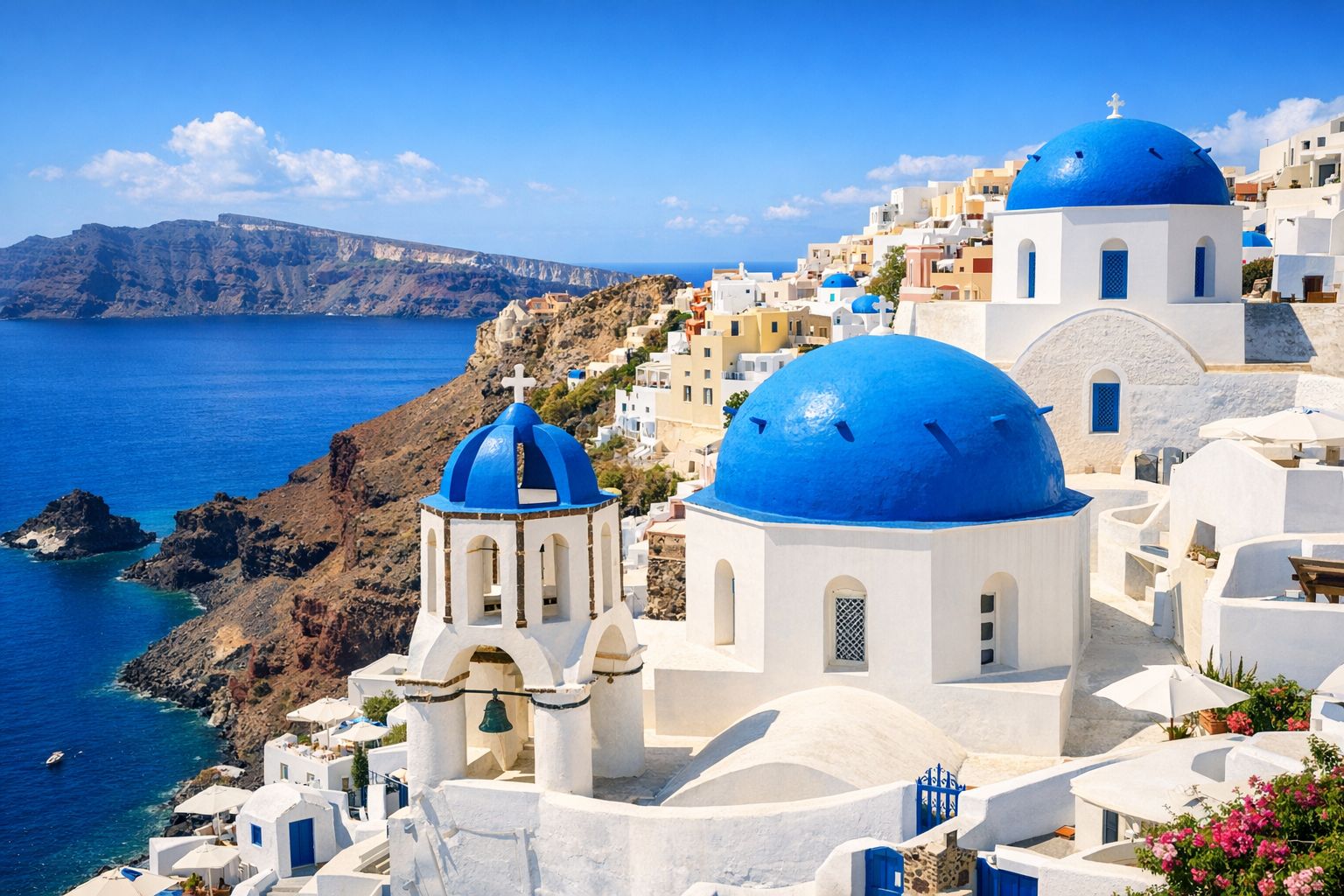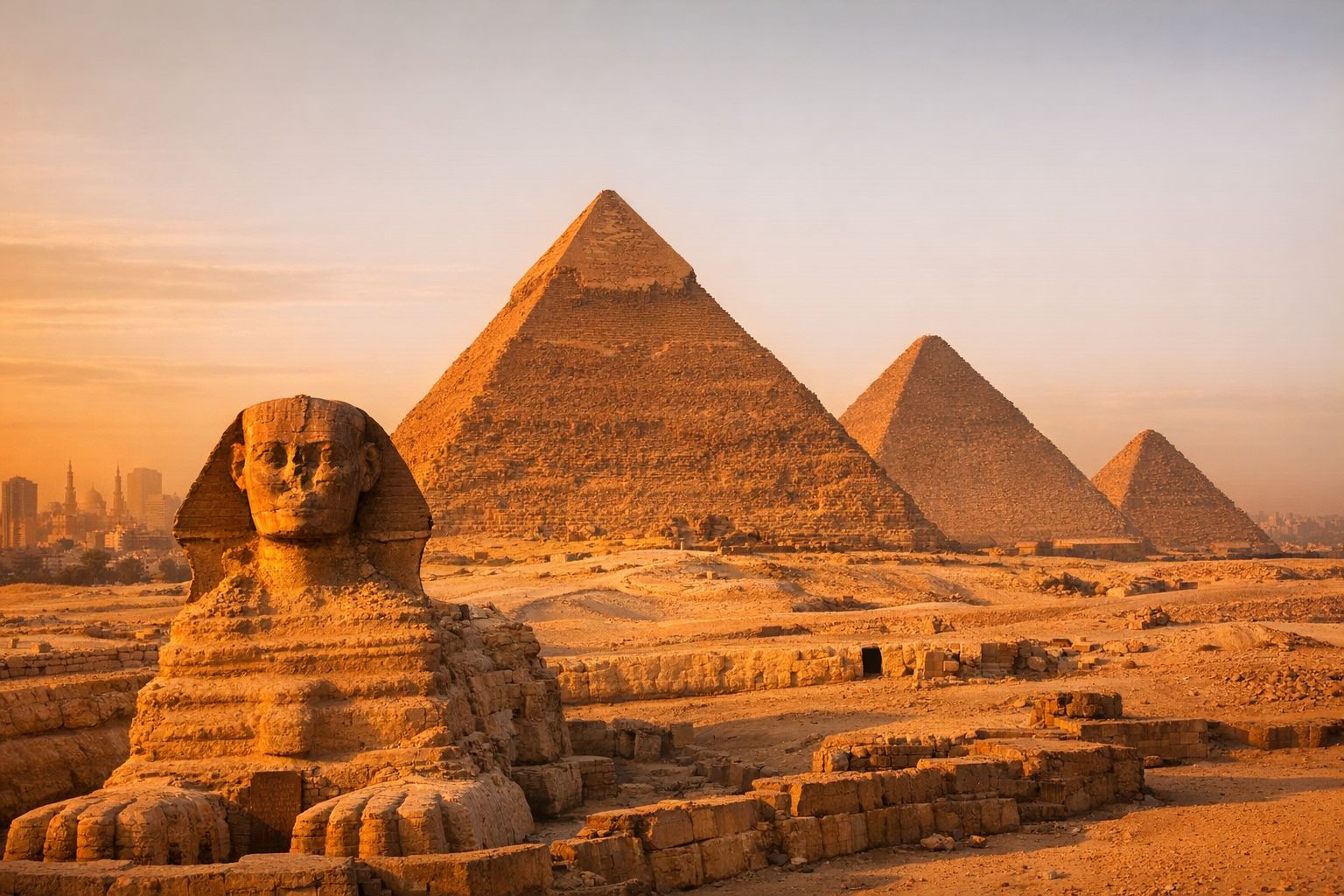
Journey through ancient wonders
Feel the rush of adrenaline as you explore Cairo & Luxor's most thrilling landscapes. This package is designed for those who believe holidays should be filled with excitement, new challenges, and the kind of experiences that make your heart race. Come home with incredible stories and unforgettable memories.
Egypt's twin treasures offer a journey through 5,000 years of civilization, from the iconic Great Pyramids of Giza and the enigmatic Sphinx to the colossal temples of Karnak and the Valley of the Kings. A Nile cruise between Luxor and Aswan glides past timeless desert landscapes dotted with ancient monuments. Cairo's vibrant Khan el-Khalili bazaar, the Egyptian Museum's golden treasures of Tutankhamun, and Luxor's open-air temple complexes create an awe-inspiring adventure.
7 nights in Cairo & Luxor — day by day, fact-checked
You land at Cairo International, are met and transferred to your hotel. The rest of the day is yours to settle in before the guided programme begins.
Cairo International is your entry airport. Your operator meets you and drives you to the hotel; a Giza-side hotel can be 60 to 90 minutes away because of distance and traffic. Check your arrival time and count the transfer from there. Have 30 US dollars cash ready if you buy your visa on arrival.
You land at Cairo International (CAI). The operator meets you and transfers you by private vehicle; no self-arranged transfer is needed.
CAI to central Cairo is roughly 45 to 60-plus minutes; CAI to a Giza-side hotel is often 60 to 90 minutes in heavy traffic. Count the transfer from your own landing time.
Cairo sunset is about 19:56 (7:56pm) around 21 July, so a daytime arrival still leaves light for settling in.
A visa on arrival costs 30 US dollars, cash only. Carry the exact notes so you are not caught out at the kiosk.
Draw small-denomination Egyptian pounds from a Cairo ATM early. You will want them for tipping guides, drivers and hotel staff throughout, in EGP.
Do not hail an unmetered street taxi outside the terminal. Your operator's driver is already waiting; a solo taxi at night is exactly what FCDO tells lone travellers to avoid.
Alcohol is legal in your hotel's licensed bars and restaurants but not in public or on the street.
An on-property international venue with a Nile view for a first evening you do not have to organise; alcohol is legal here as a licensed hotel venue.
Traditional Ottoman and Turkish cooking at a five-star Nile-side hotel; its signature is Hunkar Begendi, braised beef on roasted aubergine puree. A settled first-night dinner with no logistics.
The Pyramids and the Sphinx with your private Egyptologist, started early to beat the heat and the coach groups, followed by the Grand Egyptian Museum nearby.
The Giza Plateau opens at 08:00. Your guide starts at the gate so you walk the Pyramids and Sphinx before the coach groups and the worst heat. The area ticket covers the plateau but not pyramid interiors, which are separate, capacity-capped tickets your guide pre-secures.
Giza Plateau (Pyramids and Sphinx) area is open 08:00 to 16:00 daily. Interior visits to the Great Pyramid run 07:00 to 17:00 but close 12:00 to 13:00.
Area entry is EGP 700 adult / EGP 350 student for foreigners. The Great Pyramid interior is a separate EGP 1000 adult ticket; Khafre and Menkaure interiors are EGP 280 each. On this package the guide handles ticketing.
Be at the gate for the 08:00 opening. An early start beats both the coach groups and the midday July heat, which is why the guide front-loads the morning.
Water, a hat and high-factor sun cover. There are no restaurants or cafeterias named inside the archaeological site itself, so carry what you need.
The area ticket does not cover the Great Pyramid, Khafre, Menkaure or the Tomb of Meresankh III. Decide with your guide which interior, if any, is worth the separate capped ticket before you arrive.
Do not take a camel or horse ride at Giza. Welfare investigations have documented animals worked in extreme heat without adequate food or water; Airbnb stopped selling the rides in 2025 and a growing list of travel companies have gone cruelty-free. Your private guide and vehicle are the ethical way around the plateau.
Ask before photographing any individual, and never photograph children. Your guide keeps you clear of prohibited military subjects.
A separate paid, capacity-capped ticket beyond the area entry, worth doing if you handle enclosed spaces and heat; the guide secures the slot in advance.
The Grand Egyptian Museum sits close to the plateau and opened to the public in November 2025. It holds the complete Tutankhamun collection, around 5,000 pieces together for the first time since 1922, across twelve galleries with a Pyramids-view staircase. Your guide pre-secures the timed slot.
GEM galleries open 09:00 to 18:00 Sun/Mon/Tue/Thu/Fri and 09:00 to 21:00 Sat/Wed; the complex opens 08:30. Last entry is one hour before galleries close.
tickets.gem.eg states it is the only official website for GEM tickets. On this escorted package the operator or guide pre-secures your timed slot, so you do not self-book.
Twelve galleries plus the Grand Hall, Grand Stairs and Khufu's Boats Museum warrant several hours. Pair it with the plateau in one Giza-side day.
On Wednesdays and Saturdays the galleries stay open until 21:00, which suits a July trip: you can shift more of the visit to the cooler evening.
Do not buy GEM tickets from third-party resellers. The official site warns it is not responsible for tickets bought through other platforms; your operator secures the real timed entry.
The Zamalek-born Egyptian street-food brand for a fast local lunch of taameya, koshari and ful, with a branch inside the GEM atrium your guide can point to.
The complete Tutankhamun treasure, shown together for the first time since 1922, in the world's largest museum devoted to a single civilisation. This is the single most important add of the trip.
The Egyptian Museum on Tahrir Square for breadth and atmosphere, plus historic Cairo, with your Egyptologist filling the gaps left by the pieces that moved to GEM.
The Egyptian Museum on Tahrir Square is still open, 09:00 to 17:00 daily. Many royal mummies moved to NMEC and the Tutankhamun treasures moved to GEM, so its role is diminishing. Your guide focuses on what remains: the breadth of the collection and the century-old building itself.
Egyptian Museum, Tahrir is open 09:00 to 17:00 daily; the ticket window closes at 16:00.
Entry is EGP 550 adult / EGP 275 student for foreigners, with an EGP 75 foreign audio tour. On this package the guide arranges entry.
With Tutankhamun's mask and treasures now moved to the Grand Egyptian Museum, the Tahrir museum is best treated as a broad historical overview; your private Egyptologist helps make sense of its older, less-labelled displays.
Do not come to Tahrir expecting Tutankhamun's gold mask; it has moved to GEM. If your time is tight, GEM is the priority Tut stop, not this museum.
Dress modestly for the old city, mosques and souqs; women should carry a scarf for any mosque visit.
Still open and worthwhile for the sheer breadth of the collection and the historic atmosphere of the original 1902 museum, even after headline pieces moved to GEM and NMEC.
Historic Cairo and its bazaar quarter, at the pace your guide sets around the afternoon heat. Lunch is a guide-arranged stop; the afternoon is about the old streets, the mosques and the market trade rather than a rushed tick-list.
Cover shoulders and knees in the souqs and near mosques; carry a scarf. Modest dress avoids friction and unwanted attention.
Carry small-denomination Egyptian pounds for the market. Cards are unreliable at small stalls, and cash is what the souq runs on.
Agree a price before you buy anything in the bazaar, and keep tips for helpers small, frequent and in EGP. Haggling is expected; a fixed opening price is not the real one.
Do not photograph people or their children in the market without asking; written permission is required for individuals and photographing children is prohibited.
Public displays of affection between couples are discouraged in these more traditional quarters.
Koshari, the rice, macaroni, lentils, chickpeas and fried-onion bowl in a spiced tomato-vinegar sauce, is the classic cheap Cairo lunch; your guide can point you to a counter for an authentic quick bite.
The included domestic flight moves you south to Luxor, then Karnak Temple with your guide once the afternoon heat begins to ease.
The package's included domestic flight moves you from Cairo to Luxor in about an hour and a quarter. Driving the same route would take nine to twelve hours, which is not how this trip moves. Your guide and driver handle the airport and the transfer at both ends.
The included domestic flight covers Cairo to Luxor in roughly 1h15. The road alternative is 9 to 12 hours and is not part of this product.
FCDO warns accidents are common due to variable road conditions, dangerous driving and poor enforcement, and to avoid driving outside main cities at night. The included flight and private driver are the safe model.
Keep tipping cash in Egyptian pounds handy for the Luxor driver and hotel staff on arrival; the tipping habit continues on the Nile stretch just as in Cairo.
You do not need to arrange transport yourself: this trip runs on a private driver and guide end to end, so there is no juggling taxis or ride-hailing apps between sites.
Karnak Temple is open until 17:00, and the ticket includes the Karnak Open Museum. Luxor heat routinely passes 40C in July, so your guide times the visit for the cooler late afternoon. The Temple of Mut is a separate ticket if you want more.
Karnak Temple is open 06:00 to 17:00 daily. The ticket includes the Karnak Open Museum.
Karnak is EGP 600 adult / EGP 300 student for foreigners; the Temple of Mut is a separate EGP 200 / 100 ticket. On this package the guide handles entry.
Luxor sunset is about 19:42 (7:42pm) around 21 July, so a late-afternoon start still leaves good light across the columns.
Ask your guide about the Karnak Open Museum, which is already covered by your ticket; many day-trippers skip it and miss reconstructed chapels in the process.
Do not try to power through Karnak in the midday sun. Upper Egypt tops 40C in July; the guide front-loads mornings and pushes big open sites to late afternoon for a reason.
The vast temple complex of Karnak, with the Karnak Open Museum included in the ticket; a late-afternoon visit sidesteps the worst of the July heat.
An early crossing to the Luxor West Bank for the royal tombs, timed for the coolest part of the day, with premium tombs available as separate tickets.
The Valley of the Kings opens at 06:00, and your guide starts early so you are inside the tombs before the West Bank bakes. General admission covers three tombs; electric visitor cars now run within the site. Tutankhamun, Seti I and Nefertari are separate premium tickets.
The Valley of the Kings is open 06:00 to 17:00 daily; the standard ticket typically admits you to three tombs.
General admission is EGP 750 adult / EGP 375 student (foreigner). Premium tombs are separate: Tutankhamun EGP 700, Ramesses V/VI EGP 220, Seti I EGP 2000; Nefertari in the Valley of the Queens is EGP 2500.
Aim for the 06:00 opening. The West Bank has almost no shade, so the first hours are the only comfortable ones in July.
Electric visitor cars now run inside the archaeological area, sparing you the hot open walk between tomb entrances; ask your guide to use them.
Do not assume your entry covers the headline tombs. Tutankhamun, Seti I and Nefertari are separate premium tickets on top of the three tombs in general admission; decide with your guide which are worth it.
Camera rules vary by tomb and some carry photo fees or bans; follow your guide and never photograph other visitors without asking.
The royal necropolis, with general admission covering three tombs and electric visitor cars operating within the archaeological area; an early start beats the West Bank heat.
One of the valley's premium tombs, a separate paid ticket beyond general admission; worth discussing with your guide if you want the finest painted decoration.
The classic mid-Nile temples of Edfu and Kom Ombo on the way south to Aswan, with Kom Ombo's long evening hours letting you finish in the cool.
Edfu, the Temple of Horus, is among the best-preserved in Egypt and opens early. Your guide times it for the morning while it is still workable in the heat. This is the first of the two classic temples on the Luxor-to-Aswan corridor.
Edfu (Temple of Horus) is open 07:00 to 17:00, and 06:00 to 17:00 on Sundays and Wednesdays.
Edfu is EGP 550 adult / EGP 275 student for foreigners. On this package the guide arranges entry.
On a Sunday or Wednesday Edfu opens an hour earlier at 06:00; if your day falls right, ask your guide to start then and beat both heat and crowds.
Do not linger at Edfu into midday expecting to add Kom Ombo comfortably in full sun. Pace the two temples so the second falls in the cooler part of the day.
Water and sun cover; these Nile temples are largely open to the sky.
One of the best-preserved temples in Egypt and a classic mid-Nile stop, taken in the cooler morning on the way south to Aswan.
Kom Ombo, the double temple to Sobek and Haroeris, stays open until 21:00, unusually late among the Nile sites. Your guide uses those long evening hours so you finish in the cool, then continues to Aswan for the night.
Kom Ombo Temple is open 07:00 to 21:00, with unusually long evening hours among the Nile sites.
Kom Ombo is EGP 450 adult / EGP 225 student for foreigners. On this package the guide arranges entry.
Aswan sunset is about 19:38 (7:38pm) around 21 July; Kom Ombo's 21:00 close means you can visit after dark once the temperature drops.
Use Kom Ombo's late hours to your advantage: an after-sunset visit in July is far more comfortable than the same temple at noon.
Do not wade or dip in the Nile at any stop along the corridor. Schistosomiasis (bilharzia) risk means all freshwater contact is off-limits.
The unusual double temple to Sobek and Haroeris, with long evening hours that let you visit in the cool of the day rather than the July heat.
Philae Temple by motorboat in Aswan, with the option to add Abu Simbel by short flight rather than the long desert drive.
Philae, the Temple of Isis on Agilkia Island, is reached by motorboat and opens at 07:00. UNESCO relocated the monuments to Agilkia in the 1960s to save them from the rising Nile. Your guide times the crossing for the morning, before the Aswan heat peaks.
Philae Temple opens 07:00 to 16:00 (summer hours can run to 17:00) and sits on Agilkia Island, reached by a short motorboat from the Shellal landing.
Philae is EGP 550 adult / EGP 275 student for foreigners; the Panorama of the Temples of Philae is a separate EGP 200 / 100 ticket. On this package the guide arranges entry.
The temple was moved stone by stone to Agilkia to escape the rising Nile; ask your guide to point out the original island so the rescue makes sense on the ground.
Do not trail your hand in the water on the motorboat crossing. Freshwater contact carries bilharzia risk, so keep to the boat.
Water, a hat and sun cover for an exposed island site and the open boat crossing.
The Temple of Isis, UNESCO-relocated to Agilkia Island in the 1960s and reached by motorboat; a morning visit sits ahead of the Aswan heat.
Abu Simbel, the Great Temple of Ramesses II and the Temple of Nefertari, is the standout southern add. From Aswan the flight is about 45 minutes each way, against a three-hour road drive. On a July trip, take the flight; skip the long overland convoy in the heat.
From Aswan the Abu Simbel flight is about 45 minutes each way, against a roughly 3-hour road drive each way. The flight keeps it to a single manageable day.
The Abu Simbel temples are open 06:00 to 17:00; entry is EGP 750 adult / EGP 375 student for foreigners.
A flight-based day trip from Aswan is published from USD 725 solo, USD 625pp for a couple, down to USD 575pp for five or more, including the EgyptAir flight, private van and Egyptologist guide; gratuities are excluded.
Fly, do not drive, to Abu Simbel on a July trip. The flight is about 45 minutes each way; the road is three hours each way in extreme Upper-Egypt heat, and a 6-hour driving round-trip is hard to justify.
Do not book Abu Simbel expecting the twice-yearly sun alignment in July; it falls only on 22 October and 22 February, so it is not part of a July visit.
The Great Temple of Ramesses II and the Temple of Nefertari, reached by a short flight that keeps the standout southern site inside a single day without a 6-hour desert round-trip in July heat.
Your operator transfers you for the journey home. The morning flexes around your departure time; pack tips and paperwork the night before.
Your operator transfers you for the flight home. Count back from your departure: the domestic hop from the Nile stretch to Cairo runs about an hour to an hour and a half, and Cairo traffic adds to any airport run. Whether you leave early or late, the driver is arranged around your schedule.
The operator's driver handles the final transfer to the airport. Check your departure time and count the transfer back from it; no self-arranged transfer is needed.
If you fly out of Aswan or Luxor, allow for a domestic connection to Cairo of roughly 1h15 to 1h30 plus airport time, so plan the morning around your departure rather than a fixed hour.
You can take out only up to 5,000 Egyptian pounds. Spend down or convert excess EGP before you leave rather than carrying more than the limit.
Set aside small Egyptian-pound notes the night before for final tips to your guide, driver and hotel staff; it is customary and easier than scrambling on the morning you leave.
Do not leave controlled medication packing to the last minute or bring undeclared quantities; carry your GP letter, since controlled medicines without permission can be confiscated and prosecuted at the border.
Practical details verified 21 July 2026. Prices and opening hours change — we re-check them monthly, but confirm anything critical before you travel.
Real-time hotel prices for Cairo, Luxor and Aswan. Upgrades are shown over each location's included hotel.
Select your preferred hotel tier above. Prices vary by hotel category.
We don't yet have confirmed facility details for this property, and we'd rather tell you that than guess. Call us on 0208 944 4514 and we'll confirm exactly what this hotel offers before you book.
Select your preferred airline and cabin

Tell us what you're dreaming of — the sun, the vibe, the budget — and we'll tailor it around you and call you back. No queues, no bots, and no pressure.
Pop in your details and pick a time — an advisor calls you back, usually within the hour.
Prefer to plan it properly? Book a focused 15-minute call with a destination specialist.