Temples, geishas and zen gardens
This isn't just sightseeing — it's a journey into the heart of Kyoto's rich heritage. Walk through centuries of history, taste authentic flavors passed down through generations, and connect with traditions that have shaped this remarkable destination. Every moment becomes a story to tell.
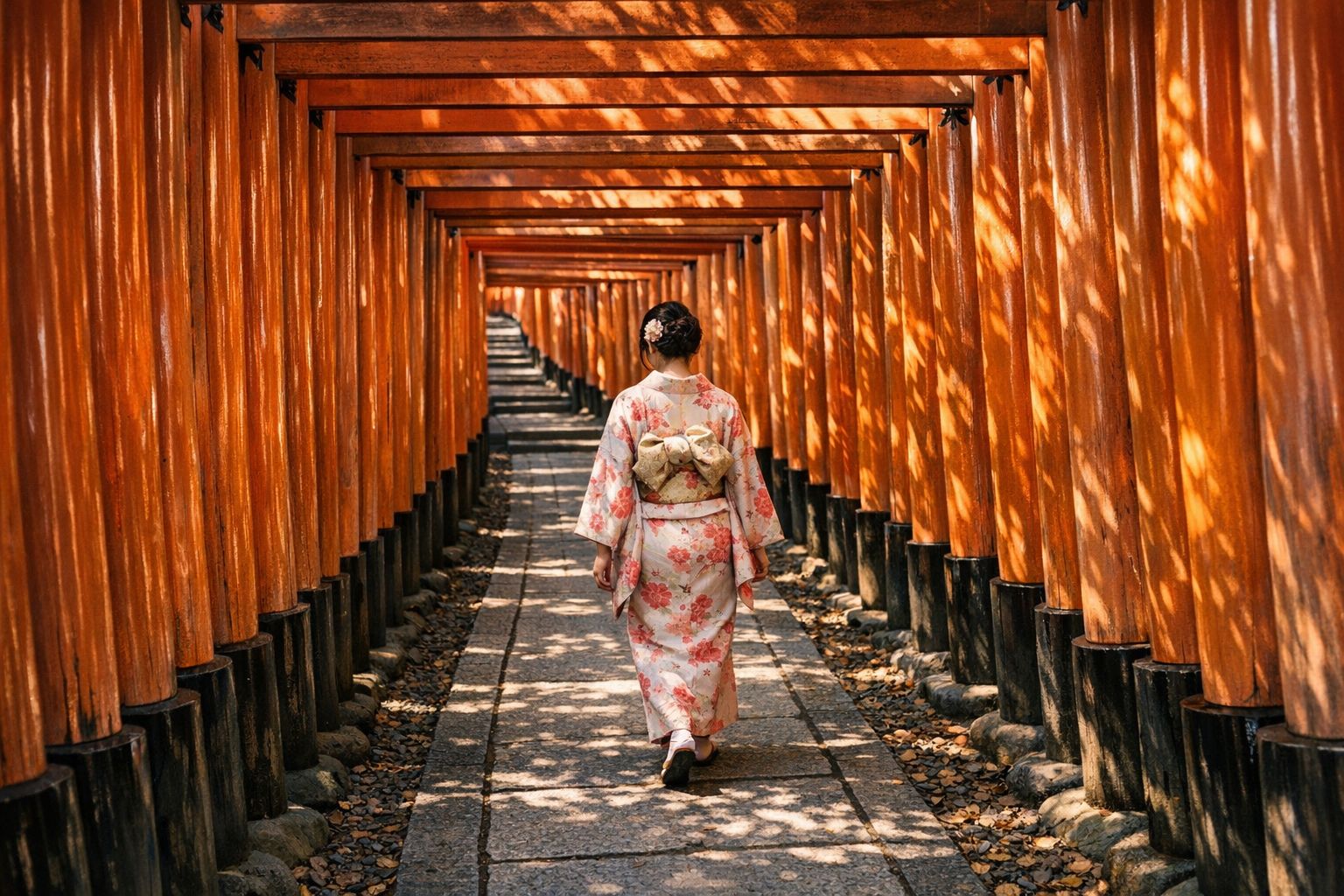
Ten thousand vermillion torii gates, the whisper of bamboo in the wind, and geiko gliding through twilit streets — Kyoto is Japan distilled to its purest essence. You'll walk ancient Zen gardens designed to calm the mind, take tea in a 400-year-old ceremony, and witness centuries of artistry in a single kaiseki meal.
5 nights in Kyoto — day by day, fact-checked
Land at Kansai International, take the HARUKA train to Kyoto, settle into the ryokan and set up an IC card and yen for the days ahead.
Your airport is Kansai International, in Osaka, not Kyoto. Budget about 75-90 minutes to Kyoto Station by train, not a short taxi. The direct JR West HARUKA limited express is 2,200 yen one-way for foreign visitors, booked online before you fly. Check your arrival time and plan the transfer around it.
KIX to Kyoto Station is roughly 75-90 minutes. The only direct train is the JR West HARUKA limited express, a discounted 2,200 yen one-way for foreign visitors, booked online in advance (reservable from one month before boarding, not sold within Japan). Exchange the e-ticket on your passport as a Temporary Visitor.
Carry yen from the airport. Reload from a 7-Eleven (Seven Bank) or Japan Post ATM, which take foreign cards 24/7 with English menus. Plan roughly 20,000-30,000 yen per person for the trip.
Set up an IC card (ICOCA, Suica or PASMO, all accepted on Kyoto bus and subway) at a station or convenience store. If a card fails to read, the official fallback is to pay by cash, so keep coins on hand.
Late July is hot and humid, with a daily maximum near 32.0C and monthly rain of 223.6mm. Pack light breathable clothing, a hat and a compact umbrella.
At the ryokan, remove outdoor shoes where tatami mats are present — the tourism board notes many areas do not permit outdoor shoes.
Do not assume a short taxi from the airport. KIX is in Osaka Prefecture, not Kyoto; the transfer is a roughly 1.5-hour train ride. Booking the HARUKA online beforehand avoids the queue.
Once you have your yen and IC card sorted, keep the first evening close to base. Sunset falls late, around 19:03 to 19:11 in late July, so there is daylight for a short walk near the ryokan. A casual ramen or izakaya generally takes walk-ins, so no booking is needed tonight.
Late-July sunset in Kyoto is roughly 19:03 to 19:11, with about 14 hours 15 minutes of daylight. Evenings stay light, but temples close near 17:00.
For tonight, casual ramen and izakaya generally take walk-ins. For higher-end kaiseki later in the trip, have the ryokan front desk phone-book — many take phone-only reservations and some refuse first-time guests without an introduction.
Do not tip. The tourism board states tipping is not a custom in Japan; a simple thanks lets staff know you were satisfied.
Do not try to book a top kaiseki spot online at the last minute. OpenTable is thin in Japan; the real platforms are Tabelog, TableCheck, Pocket Concierge and Gurunavi, and peak-season tables need booking about a month ahead.
Casual ramen counters take walk-ins, so a first-night meal needs no reservation while you are still finding your feet.
Front-load the Golden Pavilion in the morning before crowds and heat build, then keep the afternoon flexible around northwest Kyoto.
Kinkaku-ji opens 09:00-17:00 daily and admission is 500 yen. It is a walk-around-the-pond viewing temple, so a visit runs about 15-45 minutes. Arrive at opening: crowds and coach tours build fast, and it closes by late afternoon. Take city bus 12, 59, 205 or M1 to Kinkakuji-michi.
Kinkaku-ji is open 09:00-17:00 daily, all year round. Hours may change for special exhibitions.
Admission is 500 yen for adults and 300 yen for primary and middle school students. The fee may change for special exhibitions.
Take Kyoto City Bus route 12, 59, 205 or M1 to the Kinkakuji-michi stop.
Allow about 15-45 minutes — it is a walk-around-the-pond viewing temple, not an enterable building.
Arrive at opening. This is a flagship site where crowds and coach tours build fast, and it closes at 17:00, so sightseeing is front-loaded into the morning.
Bring cash for the gate. Temple admissions are best treated as cash, and there is no card guarantee at the entrance.
No guide is compulsory — the temple is self-guided. Groups over 30 should arrange entry, but there is no group discount.
Do not arrive mid-morning expecting a quiet pond. The site is small and gets packed; the earlier you tap in, the clearer the view of the pavilion.
The gold-leaf pavilion over its reflecting pond is Kyoto's signature northwest sight, and a short circuit suits an early start before the heat.
With the Golden Pavilion done, pick one afternoon anchor. Nijo Castle runs 08:45-17:00 with last entry 16:00, grounds 800 yen or 1,300 yen with the palace. Ginkaku-ji, the Silver Pavilion, runs 08:30-17:00 and costs 1,000 yen. Both are self-guided and bus-served.
Nijo Castle is open 08:45-17:00, with entry until 16:00.
Nijo Castle is 800 yen for the grounds, or a combined 1,300 yen for grounds plus the Ninomaru-goten Palace. Ginkaku-ji is 1,000 yen for adults.
Ginkaku-ji is reached by city bus 5, 7, 32, 102, 203 or 204 to Ginkakuji-michi, or EX100/105 to Ginkakuji-mae.
No guide is compulsory at either site. Nijo Castle offers an optional guided tour only; Ginkaku-ji is self-guided.
If it is a Tuesday in July, Nijo Castle's Ninomaru-goten Palace interior is closed, so the combined ticket loses value — pick Ginkaku-ji or the grounds-only ticket that day.
Ginkaku-ji's summer hours are 08:30-17:00 (Mar 1-Nov 30), so an early-afternoon arrival still leaves time before close.
Do not buy the 1,300 yen Nijo combined ticket on a July Tuesday — the palace interior is shut on Tuesdays in July, so you would pay for a room you cannot enter.
The shogun's Kyoto residence with its Ninomaru palace pairs a flat, walkable site with the morning's pavilion for a full first sightseeing day.
The Silver Pavilion's moss and sand gardens make a quieter northeast alternative to Nijo, at the foot of the Philosopher's Path.
The package's guided temple tour anchors the day, with Kiyomizu-dera and the Higashiyama lanes as the classic eastern-hills walk.
Today the package's guided temple tour leads the morning. The operator sets the exact route, meeting point and timing, so confirm those with them directly. Whatever the itinerary, temple gates want cash for admissions and charms, and the golden rule holds: an early start beats the coach crowds.
The specific temple-tour route, duration and meeting point are set by your tour operator — confirm them directly rather than assuming a fixed schedule.
Carry yen for the day: temple and shrine admissions, offering boxes and omamori charms are best treated as cash.
Dress is casual and modest. Remove outdoor shoes where tatami mats are present in temple interiors.
Kyoto's flagship temples are front-loaded into the morning because most close by late afternoon; an early start beats coach-tour and peak-season crowds.
Smoke only in designated areas and never while walking — street-smoking outside designated zones is an enforcement issue in Kyoto.
Do not treat the tour times as guesswork. The route and meeting point come from the operator, not a generic template — confirm them so you are not left waiting at the wrong gate.
A guide unpacks the meaning behind the halls and gardens you would otherwise walk past, which is why the tour is built into the package.
Kiyomizu-dera sits in the eastern hills, open 06:00-18:30 in July, admission 500 yen. Reach it on bus 206 to Gojo-zaka or Kiyomizu-michi, then a roughly 10-minute uphill walk through Higashiyama. The Sannenzaka and Ninenzaka approach lanes are steep, busy and best done earlier in the day.
Kiyomizu-dera is open 06:00-18:00, extended to 18:30 in July and August; special evening illuminations can run until 21:30 with last entry 21:00.
Admission is 500 yen for adults.
Take bus 206 from Kyoto Station (about 15 minutes, 230 yen) to Gojo-zaka or Kiyomizu-michi, then a roughly 10-minute uphill walk through Higashiyama.
Water and a hat. Extreme heat is a real risk in July, often above 35C, so hydrate on the uphill approach.
The roof restoration completed in 2020, so there is no active renovation obscuring the main hall.
Do not save the Sannenzaka and Ninenzaka lanes for peak afternoon. These atmospheric approach streets get very crowded — they are better walked earlier when the crush is lighter.
The great wooden veranda over the hillside is the eastern-hills landmark, and the walk up through Higashiyama's lanes is half the reason to go.
The stone-stepped preserved streets below Kiyomizu-dera are the classic Higashiyama walk, best taken on foot between sights.
Collect the included kimono early, keep to the public Gion streets, and observe the district's rules — the private alleys are barred and photographing geiko needs consent.
Start the kimono day early. Rental shops open in the morning and garments are returned by shop close, so an early collection gives the fullest day. The operator sets your specific shop, price and return time, so confirm those on booking. Dress modestly underneath and plan to move gently in the garment.
Start early — kimono-rental shops open in the morning and garments must be returned by shop close, so a morning collection gives the fullest day.
Your specific kimono shop, price and same-day return time come from the tour operator's booking — confirm these directly rather than assuming a fixed price or hours.
Remove outdoor shoes where tatami mats are present. Kimono-rental wearers still observe the same shoe, smoking and photography etiquette at temples and in Gion.
Smoke only in designated areas and never while walking — the rule applies whether or not you are in a rented kimono.
Do not collect the kimono in the afternoon. Shops require same-day return by close, so a late start cuts your wearing time and risks a rushed handback.
A fitted kimono for the day is built into the package; the shop dresses you and sets the return time, so it needs no separate booking.
In kimono, keep to Gion's public streets — Yasaka Shrine, Tatsumi Bridge, the Hanamikoji public stretch. Since April 2024 several private alley-streets are barred to tourists, with signage warning a 10,000 yen fine for entering. Do not chase or photograph maiko or geiko without consent. Return the garment before the shop closes.
Since April 2024, several private alley-streets in Gion are barred to tourists, with signage warning a 10,000 yen fine for entering. The public streets and Yasaka Shrine remain open.
Photographing maiko or geiko without consent is prohibited. Do not chase, touch or photograph them without permission — this applies to kimono-rental wearers too.
Do not tip anyone in Gion — tipping is not a custom in Japan and can cause confusion; a simple thanks is enough.
Return the kimono before the shop closes; plan the afternoon around the shop's stated handback time.
Do not step down a roped or signed private alley for a photo. Those lanes carry a 10,000 yen fine and the public streets around Yasaka Shrine give the same setting without the risk.
The vermilion gate at the head of Gion's main street stays open to visitors and makes a natural, rule-safe backdrop for kimono photos.
The public canal-side and the open stretch of Hanamikoji are the parts of Gion you are allowed to walk, unlike the barred private alleys.
Beat the crowds at the 24-hour Fushimi Inari torii gates early, then cross to Arashiyama for the bamboo grove and Tenryu-ji before temples close.
Fushimi Inari's grounds are open 24 hours and admission is free, which makes early morning the crowd-beater window before day-trippers and coaches arrive. The Senbon Torii gates climb Mt. Inari; the full loop takes about 2-3 hours with a midway shop. It sits directly in front of JR Inari station.
The shrine grounds are open and accessible 24 hours a day, year-round. Staff and shops operate 09:00-17:00, but the grounds themselves are always accessible.
Admission is completely free — there is no entrance fee, only voluntary offerings.
Take the JR Nara Line to Inari station, directly in front of the shrine; it is 2 stops from Kyoto Station. Alternatively the Keihan Line to Fushimi Inari station is about a 7-minute walk.
The Senbon Torii gates climb Mt. Inari; the full mountain loop takes about 2-3 hours, with a midway shop for refreshments.
Because it is open 24/7 and free, early morning is the recommended crowd-beater window, before the daytime crowds and coach tours.
Water and a hat. The trail is a real climb in July heat, often above 35C — hydrate and pace the Fushimi Inari trail.
You do not need to climb the whole mountain. The densest gate section is early on the trail, so a partial climb still delivers the torii tunnel.
Do not arrive at midday. The gates jam with crowds and coach tours through the day; arriving early is the difference between an empty torii tunnel and a queue.
The thousands of vermilion torii climbing Mt. Inari are free and open around the clock, making a dawn visit the day's clearest crowd-beater.
Cross to Arashiyama in the west for the bamboo grove and Tenryu-ji, the UNESCO Zen temple beside it. Tenryu-ji is open 08:30-17:00, 500 yen for the garden or 800 yen with buildings, reached by the Randen tram (5-minute walk) or JR Sagano Line. The grove is a short walk, best done early.
Tenryu-ji is open 08:30-17:00, with last admission 16:50.
Tenryu-ji is 500 yen for the garden only or 800 yen for garden plus buildings; the Cloud-Dragon Dharma Hall painting is a 500 yen extra.
Tenryu-ji is a 5-minute walk from the Keifuku (Randen) Arashiyama Line, a 13-minute walk from the JR Sagano Line, or a 15-minute walk from the Hankyu Line.
The bamboo grove is a very touristy, short walk best done early; at peak times it is close to a tourist trap — extremely crowded for a brief path, worthwhile mainly early in the day.
The Sagano Scenic Railway (Torokko) is a common add-on at 880 yen one-way for adults; all seats are reserved, so book ahead in peak seasons.
Do not build the day around a long midday walk in the grove. It is a short, jammed path — the value is early morning; pair it with Tenryu-ji's garden for a fuller stop.
The UNESCO Zen temple's pond garden sits right beside the bamboo grove, so one stop covers Arashiyama's two headline sights.
The towering bamboo path is Arashiyama's signature walk, but it is short and mobbed by day, so it earns its place only very early.
The open-carriage sightseeing train up the Hozugawa gorge is the classic Arashiyama add-on, with reserved seats worth booking ahead.
Count back from your flight for the roughly 1.5-hour train to Kansai Airport, settle the ryokan and spend any leftover yen before you go.
Work backwards from your departure. Kyoto Station to KIX is roughly 75-90 minutes on the JR West HARUKA, plus check-in time at the airport. Book the HARUKA one-way online before you need it. Do the maths from your flight and leave the ryokan with margin, whether yours is an early-morning or a late-night departure.
Kyoto Station to KIX is roughly 75-90 minutes on the JR West HARUKA limited express, a 2,200 yen one-way for foreign visitors booked online. It is a train, not a short taxi — count back from your flight and add check-in time.
Spend or keep leftover yen before you go; foreign-card ATMs at 7-Eleven and Japan Post are the reload points if you need cash for the transfer.
You can add remaining IC-card value to Kyoto bus and subway on the way to the station; two IC cards cannot be tapped in the same transaction.
Keep your passport handy — the HARUKA e-ticket is exchanged on your passport, one per passport, as a Temporary Visitor.
Do not leave the transfer to the last minute. KIX is in Osaka, so allow the full roughly 1.5-hour train plus check-in; a taxi across is neither fast nor cheap.
If your flight is later, a spare few hours near the ryokan or Kyoto Station work well. Keep any luggage in a station or hotel locker, avoid committing to a distant temple you cannot exit in time, and treat the day as a buffer for the transfer rather than fresh sightseeing.
Skip a far-flung temple on departure day. Kyoto's flagship sights close by late afternoon and sit across the city, so a distant stop risks the clock — stay near the ryokan or Kyoto Station.
Do not tip on the way out either — a simple thanks to ryokan and station staff is the custom.
Do not start a 2-3 hour trail or a bookable tour on departure day. Time you would spend committed to a fixed activity is better held back for the airport transfer.
A relaxed stop by the station keeps you close to the HARUKA platform so a later flight does not turn the transfer into a scramble.
Practical details verified 18 July 2026. Prices and opening hours change — we re-check them monthly, but confirm anything critical before you travel.
Select your preferred hotel tier above. Prices vary by hotel category.
We don't yet have confirmed facility details for this property, and we'd rather tell you that than guess. Call us on 0208 944 4514 and we'll confirm exactly what this hotel offers before you book.
Select your preferred airline and cabin

Tell us what you're dreaming of — the sun, the vibe, the budget — and we'll tailor it around you and call you back. No queues, no bots, and no pressure.
Pop in your details and pick a time — an advisor calls you back, usually within the hour.
Prefer to plan it properly? Book a focused 15-minute call with a destination specialist.