Where ancient meets ultra-modern
This isn't just sightseeing — it's a journey into the heart of Tokyo's rich heritage. Walk through centuries of history, taste authentic flavors passed down through generations, and connect with traditions that have shaped this remarkable destination. Every moment becomes a story to tell.
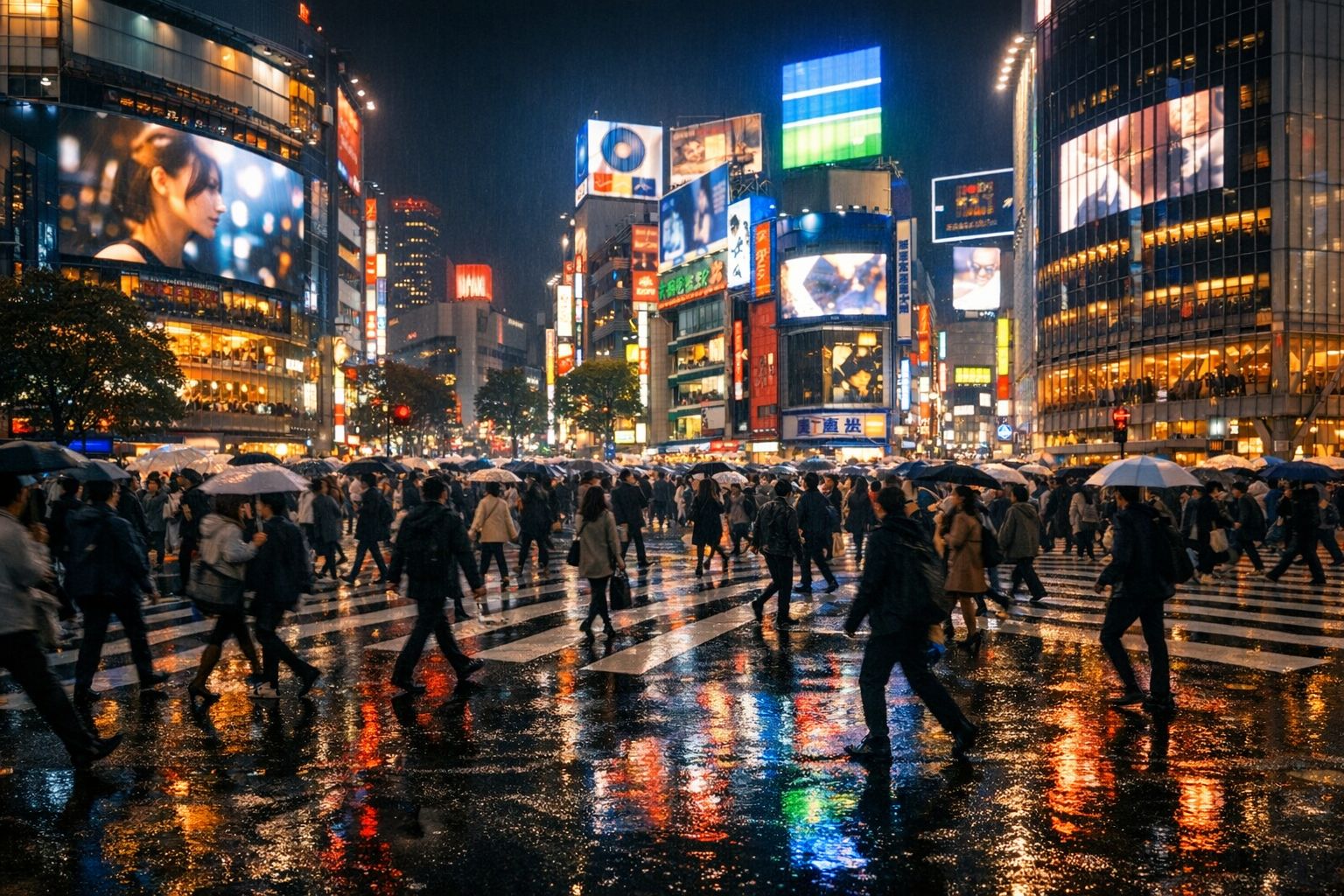
Neon-drenched Shinjuku alleyways give way to the hushed reverence of ancient Senso-ji and the otherworldly immersion of teamLab — all in a single day. You’ll ride bullet trains to Mount Fuji, sip matcha in centuries-old tea houses, and discover why Tokyo’s 200-plus Michelin stars barely scratch the surface of its culinary obsession.
7 nights in Tokyo — day by day, fact-checked
Land at Narita, clear immigration the right way, activate the JR Pass and get into the city by rail. Narita is about 60 km east in Chiba, so the transfer is a real journey, not a hop.
Narita sits about 60 km east of Tokyo in Chiba, so budget for a long transfer whatever time you land. At immigration, ask a clerk for the Temporary Visitor stamp before you leave the hall. Activate the JR Pass, then ride the Narita Express in, roughly 1 to 1.5 hours. Buy a Suica or Pasmo for the subway.
The rail transfer from Narita to central Tokyo is roughly 1 to 1.5 hours by Narita Express (N'EX), which is a JR limited express covered by your JR Pass. The faster Keisei Skyliner is not covered by the pass.
At immigration, actively request the 'Temporary Visitor' stamp from a clerk. Automated gates apply no stamp, and without it the bundled JR Pass cannot be exchanged or used.
Buy a Suica or Pasmo IC card on arrival for the Tokyo Metro and Toei subway, which the JR Pass does not cover. Carry cash: Japan is a cash-first society and reliable foreigner-card ATMs are at 7-Eleven and Japan Post Bank.
Withdraw a larger amount of yen once rather than small amounts often. ATM withdrawal fees vary by time of day, and the 10,000-yen note is accepted even for small purchases.
Do not assume one card covers every train. The JR Pass is not valid on the Tokyo Metro or Toei subway, and never on NOZOMI or MIZUHO shinkansen even in an unreserved seat.
Carry your passport at all times once in Japan; police can arrest you if you cannot show your visa status. Keep it on you, not in the hotel safe.
On a late or jet-lagged arrival, a 7-Eleven or similar konbini is a reliable cash-friendly first meal and doubles as your first foreigner-card ATM stop.
Start with Tokyo's oldest temple early, before the coach groups arrive, then work the surrounding streets on foot and by JR. A gentle, walkable first full day while you adjust to the time zone.
Senso-ji's main hall opens at 6:00 and entry is free. Arrive at opening to see Tokyo's oldest temple and the Nakamise approach before coach and day-tour groups fill the grounds from mid-morning to afternoon. No guide is needed. Reach Asakusa by rail; note the subway leg needs your Suica, not the JR Pass.
Senso-ji's main hall opens 6:00 to 17:00 (6:30 to 17:00 from October to March). No admission fee is stated for the main hall, so entry is effectively free.
Arrive at opening. The Nakamise approach and grounds are extremely crowded with coach and day-tour groups from mid-morning through the afternoon.
No guide is compulsory here; the main hall is walk-in and free. Keep noise down on the trains getting there, as loud behaviour draws negative attention.
Do not turn up at 11:00 expecting calm. That is exactly when the tour coaches land; the quiet window is the first hour after opening.
A fast, cash-friendly self-service udon chain with branches across Tokyo, well suited to a rail-based lunch near a station.
From Asakusa, Tokyo Skytree is a short move across the river. Its observation decks run roughly 9:00 to 22:30 with last admission around 21:30, though hours vary by date. Book online in advance: same-day counter tickets carry a 500-yen service fee per ticket, so booking ahead saves money and skips the queue.
Advance online adult tickets start from 1,800 yen for the Tembo Deck (Floor 350) and from 3,000 yen for the combo with the Tembo Galleria (Floor 450). Same-day counter tickets add a 500-yen service fee per ticket.
Decks operate roughly 9:00 to 22:30 with last admission around 21:30, but hours vary by date, so check the official site for your day of visit.
Book online in advance to avoid the 500-yen per-ticket same-day service fee. Prices are dynamic and vary by date.
A clear evening slot gives the widest light window given the long summer opening hours, but book the timed slot first because prices are dynamic.
Do not buy at the counter on the day. You pay a 500-yen service fee per ticket and risk the queue; the online advance fare is lower.
A 24-hour tonkotsu ramen specialist with individual solo booths and one customisable bowl; handy if the evening runs late.
A forested shrine at first light, then the free East Gardens of the Imperial Palace. Watch the calendar: the East Gardens close on Mondays and Fridays, so route this day accordingly.
Meiji Jingu is a forested shrine near Harajuku, open every day and free. Opening follows sunrise and sunset, so in July it opens early, around 5:00, and closes early evening. Go at opening to see it before tour groups. No guide is needed. The separate Inner Garden fee is unconfirmed, so treat it as unknown.
Meiji Jingu is open every day year-round and free of charge. Hours follow sunrise and sunset and vary by month; from May to July it opens around 5:00 and closes around 18:10 to 18:30.
Visit early morning, before tour groups. The shrine sits in forest and is at its calmest at opening.
Entry to the shrine is free and no guide is compulsory. The separate Inner Garden (Gyoen) fee is not confirmed here, so do not assume a price.
Do not arrive mid-morning and expect the forested calm; like the temples, the quiet is in the first hour. Keep your voice down inside the precinct.
A yuzu shio ramen and tsukemen specialist a short walk from Meiji Jingu, open year-round and easy for a walkable lunch.
The Imperial Palace East Gardens (Higashi Gyoen) are free and walk-in, but close every Monday and Friday. In summer (to 31 August) they open 9:00 to 18:00, entry to 17:30. The inner palace grounds are a separate guided tour — joinable by advance application or same-day numbered ticket — not the same place.
The East Gardens are free and open 9:00 to 18:00 from 15 April to 31 August, with entry to 17:30. They are closed every Monday and Friday (holiday exceptions) and 28 December to 3 January.
Do not route here on a Monday or Friday: the East Gardens are closed on those days. Swap this block to another day if yours falls on a closure.
The gardens are free with no booking. The inner palace grounds guided tour can be joined by same-day walk-in — 300 free numbered tickets at Kikyo-mon Gate at 9:00 and 12:30, first come first served — or by advance online application. It is not advance-only.
Do not confuse the free East Gardens with the palace itself. The inner grounds need a tour booked in advance or a same-day numbered ticket from Kikyo-mon Gate.
A well-known tonkatsu house in the Aoyama/Omotesando area, a good sit-down option after the gardens.
The package's headline day out and the one justified long transfer. In July the summit trails may be open, but this is a viewing and 5th-Station-area day tour built into the package, run through the operator, and heavily weather-dependent.
This is the one deliberate long day out, roughly 2 to 2.5 hours each way by road to the Fuji or Hakone area. Book through the tour operator or package supplier, not a generic OTA. Fuji is frequently cloud-hidden, and the coach tour runs to a fixed departure without weather refunds, so treat a clear view as a bonus.
The Fuji area is roughly 2 to 2.5 hours each way by road, making this the one justified long transfer of the trip. Schedule it as a full day.
Book the Fuji tour through the package supplier or operator's own channel. This is a 5th-Station-area viewing coach tour, not a summit climb — so the mandatory ¥4,000 summit entry fee and climber pre-registration, which apply to people hiking to the top, are not something you need to arrange.
In 2026 the summit trails open in stages (Yoshida and Subashiri from 1 July; Fujinomiya, Gotemba and the summit from 10 July). Outside the season the summit is closed and any Fuji tour is a viewing trip.
The tour runs to a fixed departure and does not cancel or refund for poor visibility — it substitutes other stops instead. Fuji is often cloud-hidden, so treat a clear view as a bonus, not a guarantee.
Do not treat guaranteed Fuji views as a given, and do not book a separate DIY Kawaguchiko rail day on top of this tour. The Fujikyuko line onward from Otsuki is a private railway not covered by the JR Pass (about 1,570 yen extra each way past Otsuki), so you would duplicate cost.
Have travel insurance that covers your itinerary and planned activities — the FCDO advises exactly this. Carry cash and your passport for the day, as everywhere in Japan.
A full-day operator tour pairing Mt. Fuji's 5th Station with a Lake Ashi cruise and ropeway, with a licensed English guide, matching the package's headline excursion structure.
A day that flexes to the forecast. The Tokyo National Museum in Ueno Park is a strong typhoon or heavy-rain contingency, and if Fuji got clouded out yesterday this is the day to consider moving things around.
The Tokyo National Museum in Ueno Park is Japan's largest and oldest, and a reliable wet-weather choice. Regular Collection admission is 1,000 yen for adults; special exhibitions cost extra. It closes on Mondays. Recent hours ran 9:30 to 20:00 with last admission 30 minutes before closing. Reach Ueno on the JR-covered Yamanote loop.
General admission to the regular Collection is 1,000 yen for adults and 500 yen for university students. Special exhibitions cost extra.
Closed on Mondays (when a holiday falls on Monday it opens and closes the next day instead), plus a year-end closure. Recent hours ran 9:30 to 20:00 with last admission 30 minutes before closing.
This is your strong typhoon or heavy-rain fallback. If a storm is forecast for the Fuji day, keep this indoor day flexible and swap the two.
Do not plan this for a Monday; the museum is closed then. And budget separately for special exhibitions, which are not covered by the regular Collection ticket.
A reliable Japanese curry-rice chain with customisable spice and toppings, a dependable rail-side lunch across Tokyo.
teamLab Borderless in central Azabudai Hills is a timed-entry digital-art venue. Tickets are date-and-time-specific with dynamic pricing, typically 3,600 to 5,600 yen for an adult, plus 200 yen if bought on site, and can sell out. Book a timed slot online in advance. Hours are 8:30 to 21:00, with last entry an hour before close.
Adult 'Entrance Pass' is dynamically priced, typically 3,600 to 5,600 yen depending on date and demand, plus 200 yen if bought on site. Do not rely on one fixed figure.
Hours are 8:30 to 21:00 (some days close early at 17:00), with last entry one hour before closing.
Tickets are date-and-time-specific and may sell out, so book a timed slot online in advance rather than turning up.
Buy online, not on site, to skip the 200-yen on-site surcharge and to secure a slot before it sells out.
Do not walk up hoping for a same-day entry. Slots are timed and can sell out, and same-day on-site purchase costs 200 yen more.
A convenient yuzu shio ramen branch close to Azabudai, open late for dinner after a timed art slot.
A morning food street that only works if you go early, then an optional short rail day trip that fully uses the JR Pass. No long transfer needed, and no extra rail cost.
When the wholesale market moved to Toyosu in 2018, the surrounding Tsukiji Outer Market stayed put: a walkable food street of sushi, kaisendon, tamagoyaki, knife and tableware shops. The public window runs roughly 9:00 to 14:00. Come mid-to-late morning; stalls start closing around 13:00 to 14:00. Bring cash.
General business runs roughly 6:00 to 9:00 (professional buyers) and 9:00 to 14:00 (open to the public), quieter after 14:00. Individual shops set their own days off and many close Sundays, certain Wednesdays and New Year.
Arrive mid-to-late morning, roughly 9:00 to 11:00 — before 9:00 is professional-buyer hours. Stalls start closing 13:00 to 14:00, so this is not an after-lunch stop.
Bring cash. Small market stalls may not take cards, and Japan is cash-first day to day.
This is the Outer Market of shops and stalls, reachable on foot from Tsukiji Station. Do not conflate it with the relocated Toyosu wholesale market or its tuna auction.
Do not plan a leisurely late-morning arrival, and check the day: many shops close on Sundays and certain Wednesdays following the wholesale-market calendar.
The Outer Market's walk-and-eat stalls sell sashimi rice bowls, grilled seafood skewers and tamagoyaki on a stick, best eaten early with cash in hand.
Kamakura is the short excursion that fully uses your JR Pass: 55 minutes from Tokyo Station on the JR Yokosuka Line, under an hour each way and JR-covered. The Great Buddha at Kotoku-in, Tsurugaoka Hachimangu shrine and seaside Hasedera are mostly walkable from the station. It works as a full rail day trip.
Kamakura is 55 minutes from Tokyo Station on the JR Yokosuka Line, fully covered by the JR Pass, so there is no extra rail cost and no long transfer.
Most sights are walkable from Kamakura Station, with a local railway or monorail linking the rest. JNTO notes the area is dense enough that an overnight is 'strongly recommended', but it works as a full rail day trip.
Of the day-trip options, Kamakura is the one that costs nothing extra on rail because it is fully JR-covered, unlike Hakone (Odakyu) or Kawaguchiko (Fujikyuko).
Do not try to also fit Hakone by rail on the pass. Hakone is reached via the Odakyu line, a private railway the JR Pass does not cover, so you would pay separately for a Hakone Freepass.
A budget gyudon beef-bowl chain with a nationwide store locator, a quick near-station meal on a day of rail travel.
Your last full day for anything you missed and a considered evening out. Shibuya is metro-heavy so lean on your Suica, and take the FCDO nightlife caution seriously in the entertainment districts.
Use the day for anything the week missed. Shibuya is walkable but metro-heavy, so it leans on your Suica or Pasmo more than the JR Pass. The JR Yamanote loop reaches Shibuya Station, but many of the surrounding streets and sights sit on non-JR subway lines. Keep some cash for the smaller shops and counters.
The JR Yamanote loop reaches Shibuya, but the wider area is metro-heavy, so use your Suica or Pasmo IC card, not just the JR Pass, to move around.
Keep cash for smaller shops, counters and temples, which may not take cards even in a busy district.
If your hotel has a spa or public bath, check its tattoo policy before you go in. Onsen, baths, pools and gyms can refuse entry to visibly tattooed guests, and a cover-up may be required.
Do not assume the JR Pass gets you everywhere in Shibuya; the subway legs need a separate IC card. Tapping through JR gates alone will leave you stranded on non-JR lines.
A long-running Japanese restaurant of soba, grilled skewers and tempura, famous as the design inspiration for the Kill Bill fight-scene set, a memorable last dinner.
For a final evening, take the FCDO nightlife caution at face value. Kabukicho, Roppongi, Shibuya and Ikebukuro see increased drink-spiking and credit-card fraud. Do not follow street touts, known as kyakuhiki, into bars. Watch your drink, keep noise down, and remember drug penalties are severe even for substances taken unknowingly.
Kabukicho, Roppongi, Shibuya and Ikebukuro have increased reports of drink-spiking and credit-card fraud. Do not follow street touts (kyakuhiki) into bars; watch your drink.
Do not tip in bars or restaurants; tipping is not practised and can cause confusion. Pay the marked price and leave it there.
Do not let a tout lead you into a bar for a 'deal'. That is the exact scenario the FCDO flags for spiking and card fraud, and drug penalties apply even if a substance is found in your bloodstream unknowingly.
For a special last night, many higher-end Tokyo counters are reservation-only, often arranged by phone or through the hotel concierge, so ask the concierge to help rather than turning up.
Reverse the arrival transfer. Narita is about 60 km east of the city, so count back from your departure time and leave a generous rail buffer to the airport.
Count back from your departure time and leave a generous buffer. The rail transfer to Narita is roughly 1 to 1.5 hours by Narita Express, which your JR Pass still covers. Narita sits about 60 km east in Chiba, so this is a real journey, not a short hop. Spend any leftover yen and coins before check-in.
The rail transfer back to Narita is roughly 1 to 1.5 hours by Narita Express (JR-covered). Narita is about 60 km east of central Tokyo, so plan the leg, do not treat it as a hop.
Count back from your departure and add a generous buffer for the roughly 1 to 1.5-hour rail transfer plus airport check-in.
Spend leftover coins and small notes before you leave; the 10,000-yen note is accepted even for small purchases if you need to break one.
Do not cut the transfer fine. The airport is a long way out in Chiba, so an under-budgeted rail buffer risks the flight.
A convenience-store or station breakfast is quick, cash-friendly and lets you keep moving toward the long Narita transfer.
Practical details verified 18 July 2026. Prices and opening hours change — we re-check them monthly, but confirm anything critical before you travel.
Select your preferred hotel tier above. Prices vary by hotel category.
We don't yet have confirmed facility details for this property, and we'd rather tell you that than guess. Call us on 0208 944 4514 and we'll confirm exactly what this hotel offers before you book.
Select your preferred airline and cabin

Tell us what you're dreaming of — the sun, the vibe, the budget — and we'll tailor it around you and call you back. No queues, no bots, and no pressure.
Pop in your details and pick a time — an advisor calls you back, usually within the hour.
Prefer to plan it properly? Book a focused 15-minute call with a destination specialist.