Two kingdoms, one epic journey
Feel the rush of adrenaline as you explore Thailand & Cambodia's most thrilling landscapes. This package is designed for those who believe holidays should be filled with excitement, new challenges, and the kind of experiences that make your heart race. Come home with incredible stories and unforgettable memories.
Discover the wonders of Thailand & Cambodia, a captivating destination that offers unique experiences, rich culture, and memorable adventures. Whether you're seeking relaxation, adventure, or cultural immersion, Thailand & Cambodia promises to exceed your expectations with its warm hospitality and stunning scenery.
14 nights in Thailand & Cambodia — day by day, fact-checked
You land at Suvarnabhumi and transfer into central Bangkok. Settle in, sort your first meal, and reset to the heat before sightseeing starts.
Your included transfer runs from Suvarnabhumi into central Bangkok, roughly 30km west, on roads that carry heavy traffic. Check your arrival time and expect the drive to stretch when it is busy. Complete your Thailand Digital Arrival Card before you reach the gate — it is mandatory and checked. Keep your first plans loose.
Suvarnabhumi (BKK) sits around 30km east of central Bangkok; your included private transfer covers this leg, so you do not arrange city transport yourself.
Bangkok traffic is heavy — the airport-to-city drive can stretch well beyond its off-peak length, so build in buffer time rather than booking anything tight on arrival day.
The Thailand Digital Arrival Card (TDAC) has been mandatory since 1 May 2025 and registers online within 3 days before arrival. It is entry-blocking, so complete it before you land.
Carry a covered-shoulders, covered-knees outfit near the top of your bag — Bangkok's temple days start early, and the Grand Palace refuses entry to anyone in vests, shorts or torn trousers.
Do not plan a packed first evening around a fixed clock. Bangkok traffic and immigration queues eat arrival day; keep dinner walkable from your hotel and unplanned.
Thailand runs on Thai baht. Cards work in hotels and larger venues; street and market spend is cash, so draw a small float of baht once you are settled.
A short, low-effort first meal after a long flight; freshly cooked Thai near your hotel keeps day one simple.
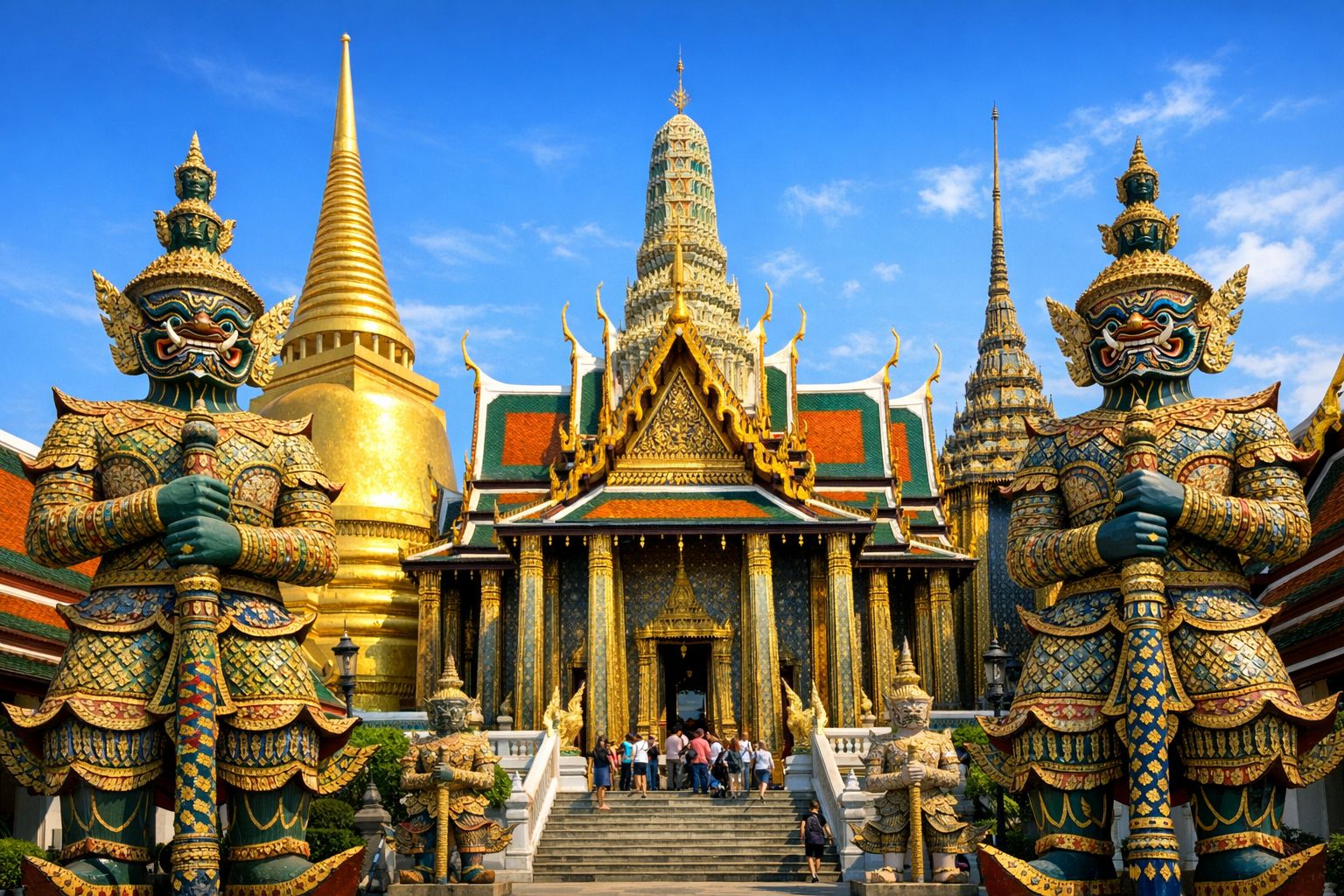
The royal old town: the Grand Palace and Wat Phra Kaew early, then the Reclining Buddha at Wat Pho next door.
The Grand Palace opens at 08:30; arrive at the gate then, before heat and coach groups build. The 500-baht foreign ticket covers Wat Phra Kaew and the Queen Sirikit Museum of Textiles. A dress code is enforced by refusal, so cover shoulders and knees. Self-guided is fine — no compulsory guide.
The Grand Palace is open daily 08:30–16:30, with tickets sold 08:30–15:30 (last entry 15:30). Foreign admission is 500 THB and includes Wat Phra Kaew.
Cover shoulders and knees. Prohibited at the gate: sleeveless shirts and vests, short tops, see-through garments, shorts, torn or tight trousers, bike pants and mini skirts.
Be at the gate for the 08:30 opening. Front-load the royal district to the cool morning; midday sun on the open courtyards is punishing.
The official page does not require a guide — self-guided is fine. Wat Pho, with the Reclining Buddha, is next door in Ko Ratanakosin, so pair the two in one morning.
Do not turn up in shorts assuming you can buy your way in with a cover-up scarf. The dress code is enforced by refusal at the gate, not a suggestion.
No licensed guide is compulsory to enter. If you want context, a reliable licensed guide adds it, but the site is straightforward to walk on your own.
Bangkok's headline royal-temple complex and the reference point for the old town; open daily and central to Ko Ratanakosin.
Wat Pho, home of the Reclining Buddha, sits beside the Grand Palace in Ko Ratanakosin and is trading and open. Across the river, Wat Arun (Temple of Dawn) is open too, though the climb is restricted to the first terrace. Both are short, walkable additions to a royal-district morning.
At Wat Arun the climb is restricted to the first terrace, so treat it as a ground-level and riverside view rather than a full ascent.
Wat Pho adjoins the Grand Palace, so you can walk between them; Wat Arun is a short cross-river hop from the same bank, keeping the whole royal cluster on foot and by boat.
Do not save these three sites for separate days across the city. They cluster in and around Ko Ratanakosin, and splitting them wastes hours in Bangkok traffic.
Bring baht cash for temple entries and river crossings; small stalls and boat fares here are cash, not card.
The reclining Buddha and Bangkok's traditional-massage temple, immediately beside the Grand Palace so it pairs naturally.
The riverside spire across the Chao Phraya from Ko Ratanakosin; open, with a short river hop from the palace side.
North to the UNESCO ruins of Ayutthaya and the Bang Pa-In Summer Palace, a chauffeured day among the old capital's temples.
Ayutthaya, the UNESCO ancient capital, sits about 1.5 hours north of Bangkok each way. A chauffeured full-day tour pairs the temple ruins with the Bang Pa-In Summer Palace. The distance is justified by the density of ruins; you are driven, not driving. Cover shoulders and knees for the temple grounds.
Ayutthaya is about 1.5 hours' drive north of Bangkok each way; the operator runs it as an ~8-hour private day with air-conditioned transport and a licensed English-speaking guide.
Bangkok Beyond's posted per-person price scales with group size — around 6,250 THB for one adult, 3,550 THB pp for two, down to 1,550 THB pp for ten.
Ayutthaya's active temple grounds follow the same modest standard as Bangkok's — covered shoulders and knees keeps you admitted everywhere on the route.
A private tour groups four temple-and-palace entries plus lunch into one chauffeured day, so you cover the UNESCO ruins and Bang Pa-In without stitching together your own transport.
Do not try to self-drive to Ayutthaya. Driving here is off-table on this trip, and a UK licence without the 1968 IDP bought in the UK can invalidate your travel insurance.
Leave early. The ruins are open and exposed, and starting in the cool morning gets you round the main temples before midday heat sets in.
A live, trading operator running a licensed-guide private full-day Ayutthaya tour with air-con transport, temple and palace entries and lunch — a clean, chauffeured way to reach the ruins.
A slower Bangkok day: an early floating-market run only if you want it, otherwise the river, markets and food on your own terms.
Damnoen Saduak floating market sits about 100km south-west of Bangkok. Honest verdict: heavily commercialised, with repetitive stalls and a short boat ride. Go before 09:00 or skip it. It only earns the early start if paired with the nearby Maeklong Railway Market — otherwise it burns a half-day for little payoff.
Damnoen Saduak is about 100km (1–1.5 hours) south-west of Bangkok and works best before 09:00, when the boats and stalls are least crowded.
Be honest with yourself: the floating market is heavily commercialised with repetitive souvenir stalls and a shorter boat ride than expected. It is worth it once, and only if you pair it with the nearby Maeklong Railway Market.
If the floating market does not appeal, spend the morning on Bangkok's river and street-food stalls instead — boat noodles, curry-over-rice and grilled skewers are a safe, mainstream way to eat well.
Do not build a whole day around Damnoen Saduak expecting a floating-village idyll. Arrive after 09:00 and you get coach crowds, premium prices and a burned half-day.
Markets are cash. Carry small baht notes for boat fares and stalls; vendors here rarely take cards.
The famous floating market, honestly a once-only: go early and only if paired with Maeklong Railway Market, or use the morning elsewhere.
For a standout dinner, Bangkok holds two Michelin-starred Thai kitchens: R-HAAN in Thonglor serving royal Thai, and Aksorn above the original Central store on Charoen Krung reviving rare dishes. Neither publishes a menu price. Book ahead — reservations are by phone or the venue's own booking widget, not a national platform.
Bangkok's higher-end restaurants take reservations by phone, hotel concierge or their own booking widget (R-HAAN via TableCheck, Aksorn via SevenRooms) — there is no OpenTable/Resy-style national network here.
R-HAAN serves dinner only, 6:00pm–11:00pm daily; Aksorn runs 6pm–10pm daily. Both are evening-only, so plan the day around a fixed dinner slot.
Neither R-HAAN nor Aksorn publishes a menu price on its site, so ask when you reserve rather than assuming a figure.
Do not expect to reserve these through a Western booking app. If you leave it to the day, you may not get in — call or use the venue's own widget in advance.
High-end venues take cards; street-food stalls do not. Keep baht cash on you for the market side of the day.
Two-Michelin-star Thai royal fine dining in Thonglor, serving a samrub (shared) format; a set-piece Bangkok dinner.
One-Michelin-star Thai rooftop restaurant by Chef David Thompson reviving traditional and rare dishes, atop the original Central store.
An internal flight north to Chiang Mai, about 700km away, then into the old city. Sightseeing eases in this evening.
Chiang Mai lies about 700km north of Bangkok, reached by your included internal flight (roughly 1h10), not by road — a road transfer would make no sense over that distance. Your transfers are handled end to end. Check the day's air-quality index before planning anything outdoors up here.
Chiang Mai is about 700km north of Bangkok and reached by internal flight (around 1h10), not road; your package supplies this leg, so you do not book it.
Check the World Air Quality Index for Chiang Mai on arrival — the FCDO confirms Bangkok and Chiang Mai pollution from seasonal crop-burning sometimes reaches dangerous levels, worst roughly late February to April.
Chiang Mai's signature dish is khao soi, a coconut curry noodle soup; the Old City and night markets are the reliable place to try it and other Northern Thai stalls.
Do not assume you'll transfer to Chiang Mai by coach or self-drive. It is an internal flight; treating a 700km northern leg as a road transfer would be unjustifiable.
You are still in Thailand, so it is baht here too. Keep small notes for night-market stalls, which are cash-only.
An easy first Chiang Mai meal after the flight; khao soi and night-market stalls are the safe, mainstream introduction to Northern Thai food.
The hilltop temple of Wat Phra That Doi Suthep above the city, then the Old City's lanes and Northern Thai food.
Wat Phra That Doi Suthep is the active hilltop temple above Chiang Mai, reached by a short mountain drive from the Old City. Go in the cool morning, and cover shoulders and knees — the temple-dress standard applies here too. Reported hours and fees vary across sources, so confirm on arrival.
Cover shoulders and knees at Doi Suthep as at any active temple; the modest-dress standard that governs Bangkok's Grand Palace applies to Chiang Mai's temples too.
Come in the cool morning. It is a hilltop site reached by a short mountain drive, and morning light and lower heat make the outlook and the climb to the terrace easier.
Reported opening hours and the foreigner entry fee for Doi Suthep vary between sources, so treat any figure you read online as indicative and confirm at the temple.
Do not hire a scooter to ride up the mountain yourself. Hire scooters in tourist areas are often unregistered and cannot legally be used on a public road, and you are chauffeured on this trip.
Check the air-quality index before heading up, especially in the northern burning season — a hazy day flattens the hilltop view over the city.
Chiang Mai's iconic mountain temple above the city, an active site of worship with a hilltop outlook over the valley.
Back in the Old City, Huen Phen serves traditional Chiang Mai food and describes over 62 years in service, with an Old City address on Ratchamanka Road and a Nimman branch. Its site does not publish hours or prices, so confirm locally. This is where to eat Northern Thai rather than tourist-strip fare.
Huen Phen's own homepage does not publish opening hours, an exact address or prices, so confirm hours and current status locally on arrival.
Order the Northern specialities — khao soi and Chiang Mai curries — at a long-running local kitchen rather than a tourist-strip restaurant; night-market stalls are the other safe bet.
Do not rely on online hours for a place like Huen Phen. Its site lists none, and turning up on stated-but-unverified times risks a closed door — check the day of.
Northern Thai kitchens and night markets are largely cash; keep small baht notes on hand for both.
A long-running traditional Chiang Mai kitchen (its site cites over 62 years) — the sort of Northern Thai spot locals actually eat at, in the Old City and at a Nimman branch.
A full day at a no-riding, no-performance elephant sanctuary — the observation-only ethics pick, never a riding camp.
Spend the day at a genuine sanctuary, not a riding camp. Elephant Nature Park runs a no-riding, no-tethering model founded by Lek Chailert; Elephant Rescue Park in Mae Taeng, about an hour north, enforces 100% no-riding and no-performances. The FCDO warns tourists have been killed when handlers lost control during elephant treks — observation only.
The FCDO warns British nationals have been seriously injured and killed when handlers lost control of the elephant during treks, and advises using a reliable, licensed tour guide — one reason to choose observation-only sanctuaries.
Elephant Nature Park publishes half-day visits at 2,500 THB and full-day programmes at 3,500 THB, with children 3 to 11 at half price.
Elephant Rescue Park is about an hour north in Mae Taeng and opens 07:00–17:00 — a morning start gives you a full sanctuary day before the afternoon heat.
Do not book a tiger selfie or cub-petting outing. World Animal Protection confirmed 72 captive tigers died at Tiger Kingdom's Mae Taeng and Mae Rim sites in February 2026 and advises tourists not to ride, hug or pose with wild animals — avoid Tiger Kingdom entirely.
Skip any camp offering elephant rides or performances. The ethical sanctuaries here exist precisely because riding, hooks and chains are the alternative — pick the no-riding model every time.
A genuine no-riding, no-tethering sanctuary founded by Lek Chailert — the safest ethics pick for a Chiang Mai elephant day, and it takes bookings on its own site.
A hands-on ethical sanctuary in Mae Taeng with a strict no-riding, no-performances, no-hooks-or-chains policy — a justifiable hour each way because it is a sanctuary, not a photo-op.
A flexible Chiang Mai day for the Old City lanes, temples and markets, paced around the heat and the air-quality index.
Use the cool morning for the Old City's temples and lanes on foot inside the moat. Cover shoulders and knees at any active temple. This is an open day to move at your own pace before the afternoon heat, with a market or food stop when it suits you.
Cover shoulders and knees for any working temple in the Old City, the same modest standard enforced at Bangkok's Grand Palace and Cambodia's religious sites.
Front-load walking to the morning and check the air-quality index first; the FCDO notes Chiang Mai's seasonal smoke haze can reach dangerous levels and worsen asthma or sinus conditions.
The Old City sits inside a square moat, so its temples are genuinely walkable between stops — you rarely need a ride within the walls.
Do not hire a scooter to zip between temples. Tourist-area hire scooters are often unregistered and illegal on public roads, and the Old City is small enough to walk.
Market and stall spend is cash in baht; keep a small float for the day and save cards for larger venues.
The walled Old City packs active temples into a compact, walkable grid inside the moat — best covered slowly on foot in the cool morning.
The cross-border leg — by air, not land — into Cambodia and Siem Reap, gateway to Angkor. Your Cambodia paperwork must already be done.
Your cross-border transfer to Siem Reap is a flight, because the Thailand–Cambodia land border remains suspended and the FCDO advises against travel within 20km of it. Cambodia needs a visa plus the free e-Arrival Card submitted within 7 days before arrival, and the US dollar is the everyday cash here — carry clean small notes.
The Thailand–Cambodia land border remains suspended and the FCDO advises against travel within 20km of it, so your cross-border transfer is by air (into Siem Reap), never an overland coach.
Cambodia requires a visa (e-visa at least 4 days ahead, or visa on arrival with a photo, paid in USD) plus the free e-Arrival Card, submitted within 7 days before you land at Siem Reap. Both are entry-blocking.
In Cambodia the US dollar is the everyday tourist cash currency. The FCDO warns fake dollar bills have been given as change in shops and clubs — check every note is genuine and not torn.
Carry clean, small-denomination USD for tuk-tuks and tips, and inspect your change; damaged or torn notes are widely refused.
Do not expect to cross the Thailand-Cambodia land border — those specific crossings are suspended, so your country-hop is a flight. Have your visa and e-Arrival Card done before you fly.
When you take change, hold each dollar note up and check it. Counterfeit USD passed as change is a documented problem in Cambodian shops and clubs.
A simple first Cambodian meal near your hotel; Khmer market and night-market eateries are the safe, mainstream introduction.
Pre-dawn to Angkor Wat, then the wider park while the crowd concentrates at the main temple. Temple passes are included.
Sunrise at Angkor Wat draws huge crowds — over 8,000 on a normal morning, and coach groups pack the reflection pools. Your temple passes are included, so go pre-dawn. Cover shoulders and knees; you can be refused entry otherwise. Ask before photographing monks, and never photograph military sites.
Sunrise at Angkor Wat draws big crowds, and the March equinox draws far more, so front-load to the cool pre-dawn. Wet season (roughly June to October) tends to have thinner sunrise crowds.
You may be refused admission at Angkor Wat if you wear skirts or shorts above the knee, and you must cover bare shoulders — dress covered for every temple this leg.
Ask permission before photographing people, especially monks and religious figures, and never take pictures on or near military bases anywhere in the Siem Reap/Angkor area.
As the mass heads for the Angkor Wat reflection pools at sunrise, move to outer temples early — you get the same cool hours with far fewer people around you.
Do not wander off marked paths chasing an empty photo angle. Cambodia is heavily affected by landmines and unexploded weapons in off-route areas, often unmarked — stay on the main temple routes.
Your package includes all temple passes, so you do not buy an Angkor ticket yourself — carry no expectation of queuing at the ticket portal.
The main temple and the centrepiece of the Angkor Archaeological Park; the classic sunrise view, best reached pre-dawn ahead of the coach crowd.
The tree-rooted Ta Prohm and outer Angkor temples, timed early to beat heat and coaches, with restoration work in progress on site.
Ta Prohm, the tree-rooted 'Tomb Raider' temple, is open during active restoration — its South Gate is being rebuilt, about 75% complete as of June 2026, so expect scaffolding in places. Pair it with the outer temples early. Cover shoulders and knees, and keep to marked routes throughout.
Ta Prohm's collapsed South Gate is being rebuilt by anastylosis, about 75% complete as of June 2026 and due to finish by end of 2026, so expect active restoration work around parts of the temple.
Come early. With over 359,000 international visitors in January–May 2026, normal park visitation continues, so the outer temples fill through the morning — the cool early hours are best.
Manage expectations at Ta Prohm — with the South Gate under reconstruction, not every corner is photogenic right now, so give the tree-root galleries the time and skip the fenced-off parts.
Do not stray off the marked temple paths for a photo. Off-route areas around Cambodia can hold unmarked landmines and unexploded weapons — stay on the trodden routes.
The covered-shoulders, covered-knees rule applies across the whole Angkor complex — dress for refusal-proof entry every temple day.
The tree-and-root 'Tomb Raider' temple, open and receiving visitors through its restoration — best seen early before coach groups arrive.
The many-faced temple at the centre of Angkor Thom, a natural pairing with Ta Prohm on an outer-temple morning.
A lighter day in Siem Reap paced around the heat, built toward a standout Khmer dinner in town.
Siem Reap does serious Khmer dining. Cuisine Wat Damnak runs market-driven set menus in a wooden house, closed Sundays; Embassy serves seasonal Khmer nightly. Cambodia is not yet in the Michelin Guide, so no venue here holds a star. Reserve ahead by phone or the venue's own widget, not a national app.
Cuisine Wat Damnak asks for reservations at least 24 hours ahead via TableCheck, phone or email; Embassy books by phone or the SpicyChef platform. There is no OpenTable/Resy-style network — reserve by phone, concierge or the venue's own widget.
Cuisine Wat Damnak serves dinner Monday–Saturday 6:30pm–11:00pm (last order 9:00pm) and is closed Sundays; Embassy is open daily 6:00pm–11:00pm.
Cuisine Wat Damnak publishes a seasonal set tasting at USD 45 per person and a vegetarian tasting at USD 38, plus 5% service and 10% government tax; Embassy and Amansara do not publish prices.
Cambodia is not yet covered by the Michelin Guide, so ignore any 'Michelin-starred Siem Reap' claim — pick these kitchens on their own merits, not a star.
Do not plan Cuisine Wat Damnak for a Sunday — it is closed, and it also closes for Khmer New Year (13–19 April 2026). Confirm the date and book 24 hours ahead.
USD is the everyday cash currency in Siem Reap; note the set menus carry 5% service and 10% tax on top, and check your change for fake or torn notes.
Market-driven Khmer fine dining in a traditional wooden house, with a seasonal set-menu format — the reference Siem Reap dinner.
Khmer fine dining using seasonal local ingredients, central and open every night — a strong alternative when Cuisine Wat Damnak is closed.
A hotel-based Khmer and international dining option open to non-residents by availability, on the Road to Angkor — useful because it needs no self-arranged transport.
An outer-temple morning toward Banteay Srei, then Siem Reap's markets, moving by grille-fitted tuk-tuk with valuables out of sight.
Take the cool morning for outer Angkor temples such as Banteay Srei, seen early while the crowd heads for the main temple. Cover shoulders and knees, keep to marked routes, and ask before photographing monks. Move by tuk-tuks fitted with metal grilles, keeping bags out of sight.
See the outer temples like Banteay Srei early while the mass heads to Angkor Wat's reflection pools — you trade the postcard sunrise for room to move and cooler air.
Prefer tuk-tuks fitted with metal grills on the back and sides — they offer some protection against bag-snatching, the most common theft here, by thieves on passing motorbikes.
Do not ride an open tuk-tuk or a moto-dop motorcycle taxi with your bag on show. Moto-dops are poorly maintained with low driving standards, and exposed bags get snatched from passing motorbikes.
Ask before photographing people, especially monks and religious figures, and never photograph military bases anywhere on the route.
At the market, check your change for counterfeit USD — the FCDO reports fake dollar bills handed back in shops and clubs — and never hand a passport over as rental collateral for anything.
The fine-carved outer temple worth seeing early while coaches concentrate on the main complex; a natural pairing with an outer-temple morning.
A last flexible Angkor and Siem Reap day — return to a favourite temple early, then pace the afternoon around the heat before you pack.
Use the final cool morning to return to a temple you want more time with, before the afternoon heat. Cover shoulders and knees, keep to marked paths, and ask before photographing monks. Travel by grille-fitted tuk-tuk with valuables out of sight, and avoid moving around after dark.
Angkor's midday heat is punishing, so keep the last temple visit to the cool early morning and treat the afternoon as low-effort, in the shade.
Travel after dark significantly increases the risk of road accidents in Cambodia, so keep any final-evening moves short and finish tuk-tuk journeys before nightfall.
Do not carry cannabis home or into transit. It is illegal to take it out of Thailand, British nationals have been caught in transit, and airport scanners catch it — a hard do-not rule as you head toward departure.
Same as every temple day: cover shoulders and knees, or risk refusal at the gate on your final visit.
Spend down or set aside your remaining clean USD for tips and the transfer, and check any last change for fake or torn notes.
A last unhurried temple morning lets you go back to whichever site you rushed — the outer temples reward a second, quieter look.
Your transfer to Siem Reap airport and the flight home. Time the morning against your departure and leave nothing to chance.
Count back from your departure to plan the morning; your included transfer takes you to the airport. Do a final counterfeit-note check on any USD change and make sure nothing resembling cannabis is in your bags — carrying it out of the region risks arrest, including in transit. Keep documents to hand.
Your included transfer runs to Siem Reap airport for the flight home; count back from your departure to set the morning rather than working to a fixed clock.
Do a final check of any USD change and set aside clean small notes for tips and the transfer — torn or fake notes are refused right up to the airport.
Do not pack anything resembling cannabis to carry home or through a transit airport. It is illegal to take out of Thailand, scanners catch it in transit, and British nationals have been arrested — a strict do-not rule.
Keep your passport, visa record and onward documents to hand; your passport must remain undamaged and complete throughout.
Cambodia runs on USD cash for tourists — carry only clean, small notes for the last day, and keep a little back for airport tips.
A low-key final stop close to your hotel before the transfer, so you are not chasing anything far from base on departure day.
Practical details verified 21 July 2026. Prices and opening hours change — we re-check them monthly, but confirm anything critical before you travel.
Real-time hotel prices for Bangkok, Chiang Mai and Siem Reap. Upgrades are shown over each location's included hotel.
Select your preferred hotel tier above. Prices vary by hotel category.
We don't yet have confirmed facility details for this property, and we'd rather tell you that than guess. Call us on 0208 944 4514 and we'll confirm exactly what this hotel offers before you book.
Select your preferred airline and cabin

Tell us what you're dreaming of — the sun, the vibe, the budget — and we'll tailor it around you and call you back. No queues, no bots, and no pressure.
Pop in your details and pick a time — an advisor calls you back, usually within the hour.
Prefer to plan it properly? Book a focused 15-minute call with a destination specialist.