ATOL PROTECTED | ABTA BONDED24/7 CUSTOMER SUPPORT
Globehunters
Croatia Holiday Guide 2026: Dubrovnik, Plitvice Lakes & Island Hopping
Back to BlogTravel Guides

Croatia Holiday Guide 2026: Dubrovnik, Plitvice Lakes & Island Hopping

Globehunters3 April 202623 min read

There is a moment — and every traveller who has been to Croatia knows exactly the one — when you round a bend on a coastal road, the Adriatic suddenly fills your entire field of vision, and you understand completely why this country has been called the Mediterranean's best-kept secret for decades. Except it isn't a secret anymore, and that is precisely why you need to plan your 2026 visit with more care, more intelligence, and more insider knowledge than ever before. Croatia has matured from a post-war curiosity into one of Europe's most compelling multi-destination holidays: ancient walled cities that predate most European nations, waterfalls that look digitally enhanced but are entirely real, islands so varied in character that hopping between them feels like visiting different countries entirely. This guide covers everything a UK traveller needs to experience Croatia at its absolute best in 2026 — the logistics, the costs, the hidden corners, and the moments that will stay with you long after the tan fades.

Croatia: An Overview for UK Travellers

Croatia occupies the eastern Adriatic coast and is one of Europe's most geographically dramatic countries — a slender nation stretched between the Julian Alps in the north and the Dalmatian coast in the south, fringed by more than 1,200 islands. It is a destination that rewards travellers who treat it as more than just a beach holiday, though the beaches alone would justify the flight.

Geography and language: Croatia sits in Southeast Europe, bordering Slovenia, Hungary, Serbia, Bosnia and Herzegovina, and Montenegro. The country divides neatly into distinct regions: the capital Zagreb in the continental north, the forested Plitvice Lakes region in the interior, the Istrian peninsula in the northwest (often called "Croatia's Tuscany"), and the spectacular Dalmatian coast stretching south through Split, the Makarska Riviera, and down to Dubrovnik near the Montenegrin border. The official language is Croatian; English is widely spoken in tourist areas, particularly among younger Croatians, though learning a handful of Croatian phrases — hvala (thank you), molim (please), dobar dan (good day) — earns immediate warmth from locals.

Currency: Croatia adopted the Euro (€) on 1 January 2023, replacing the Kuna. This simplifies matters enormously for UK travellers already familiar with spending Euros across Europe. At the time of writing, the exchange rate hovers around £1 = €1.17–€1.20, though you should always check live rates before travelling. ATMs are widely available across the country, including on most inhabited islands. Credit and debit cards are accepted in the vast majority of restaurants, hotels, and shops, though smaller konobas (traditional taverns) in rural areas may still prefer cash.

Time zone: Croatia operates on Central European Time (CET), which is GMT+1 in winter and GMT+2 during summer (CEST). In practice, during peak holiday season (June–September), Croatia is one hour ahead of the UK.

Visa requirements for UK travellers: Following Brexit, UK citizens are no longer EU citizens, but Croatia remains visa-free for UK passport holders for stays of up to 90 days within any 180-day period under the Schengen Area rules — Croatia joined the Schengen Area on 1 January 2023. Importantly, the European Travel Information and Authorisation System (ETIAS) is expected to be operational by 2026. UK travellers will need to register online before visiting Schengen countries, including Croatia. The process is expected to be simple and low-cost, but check the latest ETIAS status before booking. Your passport must be valid for at least three months beyond your planned departure date from the Schengen Area.

Electricity and practicalities: Croatia uses Type C and F plugs (two-round-pin European standard) at 230V. UK travellers will need a European plug adaptor. The country's emergency number is 112, the same as the rest of the EU.

When Is the Best Time to Visit Croatia?

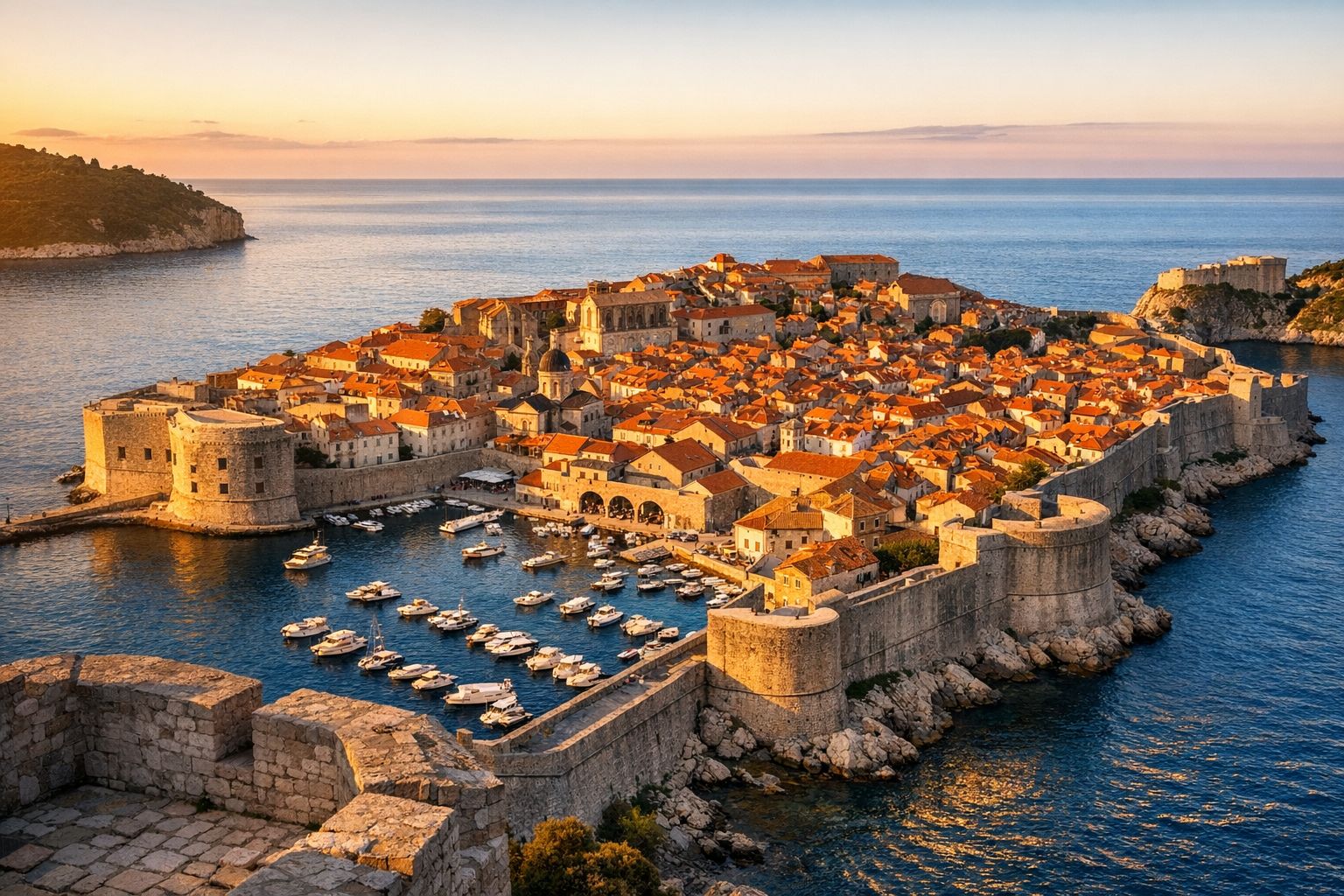
Dubrovnik old town Croatia

The best time to visit Croatia for most UK travellers is late May to mid-June or September to early October — the shoulder season offers warm temperatures, manageable crowds, and noticeably lower prices compared to the July–August peak. That said, each season offers a genuinely different experience of the country.

Month-by-Month Breakdown

January–March: Croatia's winter is mild along the coast (typically 10–14°C in Dubrovnik) but cold and snowy in the inland regions. Dubrovnik and Split are atmospheric and peaceful, with many tourist facilities closed but cultural attractions fully open. Prices are at their lowest — budget accommodation can be found for a fraction of peak-season rates. Plitvice Lakes is strikingly beautiful under snow but some pathways may be closed for safety.

April–May: Spring arrives with flowering vegetation, warmer temperatures (16–22°C on the coast), and the return of outdoor dining. The sea is still cool for swimming but perfectly pleasant for coastal walking and sightseeing. Crowds are building but nowhere near summer levels. This is an excellent window for Plitvice Lakes, which is at its most lush and green. Hotel rates begin to rise in May.

June: The sweet spot begins. Temperatures reach 25–28°C on the coast, the sea warms to a swimmable 22°C, and the crowds haven't yet reached peak intensity. Dubrovnik's Summer Festival begins in early July, but June already sees cultural programming. Prices jump noticeably mid-June as the school holiday effect kicks in across northern Europe.

July–August: Peak season in every sense. Temperatures regularly exceed 32°C, the Adriatic shimmers its most spectacular blue, and island ferries are packed. Dubrovnik in particular becomes extremely crowded — cruise ships disgorge thousands of day-trippers into the Old Town, and the narrow limestone streets can feel more like a theme park than an ancient city. If you visit in high season, arrive at major sites before 9:00 before the cruise ship crowds disembark, and consider staying an extra night or two rather than rushing between destinations.

September–October: Many experienced Croatia travellers consider September the finest month of all. The sea retains its summer warmth (still around 24°C in September), the crowds thin dramatically after the first week, and the quality of light becomes almost painterly in the late afternoon. Restaurants that were overwhelmed in August return to their best, and locals begin to re-inhabit their towns. October brings cooling temperatures (18–24°C) and the start of Croatia's truffle season in Istria — a genuine culinary event.

November–December: The off-season proper. Most island accommodation closes, ferry services reduce significantly, and the Dalmatian coast takes on a melancholy, windswept beauty. Dubrovnik's Christmas market is atmospheric and growing in reputation. Zagreb, by contrast, hosts one of Central Europe's most celebrated Christmas markets.

Our recommendation: For the classic Croatia holiday combining Dubrovnik, Plitvice Lakes, and island hopping, target 1 June – 20 June or 5 September – 30 September. You'll get genuine summer conditions at 15–30% lower cost than peak weeks.

Where to Stay in Croatia: Area Guide by Budget

Croatia's accommodation landscape is as varied as its geography, from five-star palaces in 16th-century buildings to family-run guesthouses on car-free islands. Choosing the right base — or bases — makes an enormous difference to the quality of your trip.

Dubrovnik

Staying within the Old Town walls is the most atmospheric option and commands premium prices. Apartments and small boutique hotels nestle inside medieval palaces; waking up to church bells echoing off limestone walls is an experience worth paying for. Expect to pay £180–£350 per night for quality accommodation within the walls in peak season, somewhat less in shoulder months.

The Lapad Peninsula, a 15-minute bus ride from the Old Town, offers the best value in Dubrovnik — a leafy residential neighbourhood with good beach access, quality hotels at mid-range prices (£90–£160 per night), and excellent local restaurants away from the tourist circuit. This is where many savvy travellers base themselves. The Pile neighbourhood, just outside the Old Town's western gate, splits the difference — still atmospheric, with quicker access to the walls' entrance.

Budget options: Hostels in Dubrovnik start from around £30–£45 per person per night. Private rooms in guesthouses in Lapad run £70–£100 per night for a double. The Gruz harbour area offers good-value accommodation near the ferry terminal — practical if you're island hopping.

Split

Split's old town is literally built inside and around the walls of Diocletian's Palace, a UNESCO World Heritage Site. Staying within the Palace — in one of the warren of apartments and boutique hotels tucked into 1,700-year-old Roman structures — is one of the most genuinely unusual accommodation experiences in Europe. Mid-range apartments here run £100–£180 per night. The Manuš and Varoš neighbourhoods, just west of the palace, offer a more local atmosphere with good dining options. Bačvice, a 10-minute walk east of the palace, suits beach-focused travellers with more modern hotel options.

Hvar and the Islands

Hvar Town is Croatia's most glamorous island destination and prices reflect this. Budget travellers should look at Stari Grad on Hvar — quieter, more authentic, and significantly cheaper. The island of Brač (home to the famous Zlatni Rat beach at Bol) offers excellent mid-range options. Vis, further out to sea, has a genuine off-grid quality and excellent family-run accommodation at fair prices. Korčula, often cited as Marco Polo's birthplace, combines gorgeous medieval architecture with a mellower atmosphere than Hvar at more reasonable prices.

Plitvice Lakes

For Plitvice, staying in the villages of Rastovača or Mukinje — just outside the national park — offers the best combination of access and value. Guesthouses here start from around £55–£80 per night for a double room. Book well in advance for summer visits; accommodation near Plitvice is genuinely limited.

Top Things to Do in Croatia: 10 Experiences That Define the Country

Plitvice Lakes waterfalls Croatia

Croatia's appeal spans ancient history, natural wonder, and Adriatic leisure. These ten experiences represent the essential Croatia — the ones that first-time and returning visitors alike consistently describe as transformative.

1. Walk the Dubrovnik City Walls

The 2km circuit of Dubrovnik's medieval walls is arguably the finest urban walk in Europe. Built between the 12th and 17th centuries, the walls rise up to 25 metres in places and offer panoramic views over the terracotta rooftops, the Adriatic, and the island of Lokrum. Opening hours: 08:00–19:30 in summer, shorter hours in winter. Entry cost: Adults €35 (approximately £29), children €15 (approximately £12). Insider tip: visit early morning (08:00–09:00) before the cruise ship crowds arrive, or late afternoon when the light is golden and the majority of day-trippers have departed.

2. Explore Plitvice Lakes National Park

Croatia's most visited natural attraction is a UNESCO World Heritage Site comprising 16 terraced lakes connected by a series of waterfalls, set in forested karst terrain. The water shifts from turquoise to emerald depending on the angle of light — photographs barely do it justice. Entry: €23–€40 (approximately £19–£33) depending on season and which route you walk; tickets should be booked online in advance for summer visits. The park is divided into upper and lower lakes; most visitors cover both in a full day. Opening hours: 07:00–20:00 in summer. Arrive at opening time and head to the upper lakes first — the majority of visitors start at the lower lakes, meaning the upper section is quieter in the morning.

3. Discover Diocletian's Palace in Split

The Roman Emperor Diocletian built his retirement palace on the Dalmatian coast in the early 4th century AD, and today approximately 3,000 people live and work within its walls. It is not a museum — it is a living city layered over a Roman structure. Restaurants, bars, boutiques, and apartments occupy spaces that were once imperial apartments. Entry to the palace complex itself is free, though individual attractions within (the Cathedral of Saint Domnius, built inside Diocletian's mausoleum, is €10/approximately £8) charge separately. Wander without a plan and allow yourself to be surprised by what you find around each corner.

4. Island Hop the Dalmatian Coast

Croatia's island ferry network is one of its great logistical pleasures. Jadrolinija, Croatia's national ferry operator, connects Split with Hvar, Brač, Vis, Korčula, and Lastovo. A standard car ferry from Split to Hvar Town takes approximately 2 hours and costs around €8–€12 (approximately £7–£10) per person foot passenger. The faster catamaran service takes around 1 hour. The classic island-hopping route for a 7-night stay: Split (2 nights) → Hvar (2 nights) → Korčula or Vis (2 nights) → back to Split or onward to Dubrovnik by catamaran.

5. Swim at Zlatni Rat, Brač

Croatia's most photographed beach is a striking shingle-and-pebble spit that extends 634 metres into the Adriatic from the town of Bol on the island of Brač. The tip of the spit actually shifts position with currents and winds — a geological quirk that makes it uniquely photogenic. The beach is free to access. Bol is reached by catamaran from Split (approximately 1 hour, around €15/£12 foot passenger).

6. Kayak Around Dubrovnik's Sea Caves

Sea kayaking around the base of Dubrovnik's city walls and out to the island of Lokrum is one of the best ways to experience the Old Town from a completely different perspective. Numerous operators offer half-day guided tours from around €50–€65 (approximately £42–£54) per person, including equipment and a guide who will point out geological features and historical context that most visitors miss entirely. No prior kayaking experience is required.

7. Visit the Island of Vis

One of the furthest inhabited islands from the Croatian mainland, Vis spent decades as a Yugoslav military base and was only opened to foreign tourists in 1989. This relative isolation preserved an authenticity that Hvar and Brač have largely lost. The Blue Cave (Modra Špilja) on the nearby island of Biševo is an extraordinary natural phenomenon — sunlight refracts through an underwater opening to illuminate the cave's interior in an electric blue glow, best seen between 11:00 and 12:00. Boat tours to the Blue Cave from Vis Town run approximately €35–€45 (approximately £29–£37) per person.

8. Attend the Dubrovnik Summer Festival

Running annually from 10 July to 25 August, the Dubrovnik Summer Festival is one of Europe's oldest and most distinguished arts festivals, established in 1950. Performances of theatre, opera, classical music, and dance take place in extraordinary open-air venues across the Old Town — on the city walls, in the Rector's Palace atrium, on Fort Lovrijenac. Tickets range from €15 to €120 (approximately £12–£100) depending on the performance. Book well in advance for headline events.

9. Hike to the Top of Srđ Hill, Dubrovnik

The cable car from Dubrovnik to the summit of Mount Srđ (405 metres) operates daily from 09:00–midnight in summer and costs €22 return (approximately £18) for adults. However, the 45-minute walking trail to the summit — accessed from behind the Pile Gate — is free and offers an even greater sense of achievement when the view unfolds. From the top, the geometry of the Old Town, the curve of the Adriatic, and the islands of Lokrum, Koločep, and Šipan are all visible simultaneously.

10. Truffle Hunting in Istria (October visitors)

The Istrian peninsula in northern Croatia is one of Europe's premier truffle-producing regions, and autumn truffle hunting experiences are increasingly popular with UK visitors. Guided hunts through the oak forests of the Motovun region, using trained dogs, run approximately €70–€100 (approximately £58–£83) per person and typically include a tasting lunch featuring the morning's harvest. October is the height of black truffle season; white truffles (rarer and more valuable) peak in November.

Book Your Croatia Holiday Now

GlobeHunters offers holiday packages including flights and hotels at competitive prices.

View Package & Prices →

Or call us: 0208 944 4514

Food and Dining in Croatia: What to Eat, Where to Eat, and How to Avoid Tourist Traps

Croatian cuisine is one of the Mediterranean's most underappreciated food cultures — a genuine fusion of Adriatic seafood traditions, Central European heartiness, and Ottoman and Venetian historical influences that gives the country a culinary identity entirely its own. Eating well in Croatia is not difficult; avoiding overpriced mediocrity in tourist-saturated areas requires slightly more effort.

Essential Dishes to Try

Peka is Croatia's most iconic cooking method: meat (usually lamb or octopus) is slow-cooked under an iron bell covered with embers, creating extraordinarily tender, smoky results. It requires 2–3 hours to prepare and must usually be ordered in advance at a konoba. If you see it on a menu, order it.

Black risotto (crni rižot) is made with cuttlefish or squid ink, giving it its dramatic colour and a deep, intensely savoury flavour. It is a Dalmatian classic and one of the finest things you will eat in Croatia. Expect to pay €14–€20 (approximately £12–£17) in a good konoba.

Prstaci (date mussels) were once a Dalmatian delicacy but are now protected due to overfishing — you will not find them legally on menus. Instead, look for dagnje (regular mussels), typically served steamed with white wine, garlic, and parsley, and extraordinarily fresh.

Grilled fish (riba na žaru) — sea bass, sea bream, and dentex are the species to seek. Fish is typically priced by weight (per 100g) in Croatian restaurants; always ask the weight before ordering to avoid bill shock. A whole sea bass for two will run approximately €30–€50 (£25–£42) depending on size and restaurant.

Štrukli is a baked or boiled pastry filled with cottage cheese, specific to the Zagreb and Zagorje regions — completely different from coastal cuisine and worth seeking out if you spend time in the capital.

Prošek, Croatia's traditional sweet dessert wine made from dried Dalmatian grapes, is the perfect conclusion to any coastal meal. Rakija — fruit brandy — is the national spirit and comes in numerous varieties: plum (šljivovica), herb (travarica), honey (medovača). A glass of travarica is often offered complimentary at the end of a meal in traditional konobas.

Where to Eat: The Geography of Good Food

In Dubrovnik, the tourist restaurant trap is most acute along the Stradun (the main street of the Old Town). Walk two or three streets back from the Stradun into the residential side streets — particularly around the area of Prijeko — to find better quality and lower prices, though even these have become increasingly touristic. For the best value and most authentic Dubrovnik dining, take the bus to Lapad or Gruz and eat where locals eat.

Split's dining scene has genuinely improved in recent years. The Varoš neighbourhood west of the palace has excellent konobas. The market at Pazar (just east of the palace walls) is one of the finest food markets in Dalmatia — the place to buy local cheese, cured meats, seasonal vegetables, and olive oil to take home.

On the islands, Stari Grad on Hvar consistently outperforms Hvar Town for food quality-to-price ratio. Vis has some of the finest restaurants of any Croatian island — the isolation has paradoxically preserved both ingredient quality and cooking traditions.

Dietary Considerations

Vegetarians will find Croatia manageable but not effortless in traditional konobas — pasta dishes, cheese-based options, and grilled vegetables are widely available. Vegans face more of a challenge in rural areas and traditional restaurants; coastal cities are significantly more accommodating. Coeliac travellers should note that pasta and bread are staples of Croatian cuisine; gluten-free options are available in cities but limited in rural areas and on smaller islands. Always communicate dietary requirements clearly — Croatians are generally very willing to accommodate if they understand the need.

Getting to Croatia from the UK: Flights, Routes, and Transfers

Croatian coastline island view

Croatia is well-served from UK airports, particularly during the summer months, making it one of the more straightforward Mediterranean destinations to reach from Britain.

Main Airports and Flight Routes

Dubrovnik Airport (DBV) is the gateway for the southern Dalmatian coast. Direct flights from the UK are operated by British Airways (from London Heathrow), easyJet (from London Gatwick, London Luton, Bristol, Manchester, and Edinburgh), Jet2 (from numerous UK regional airports), and Ryanair (from London Stansted and various UK airports). Flight time from London to Dubrovnik is approximately 2 hours 45 minutes to 3 hours. Return flights in shoulder season (May–June, September) typically range from £120–£250 per person; peak season (July–August) prices regularly exceed £350–£500 per person return.

Split Airport (SPU) serves the central Dalmatian coast and is the ideal arrival point for itineraries combining Split with island hopping and Plitvice Lakes. Direct flights from the UK are operated by easyJet, Jet2, Ryanair, and British Airways. Flight time from London is approximately 2 hours 30 minutes. Split is also a logical starting point for a "Split to Dubrovnik" route, travelling south via the islands and finishing in Dubrovnik before flying home.

Zagreb Airport (ZAG) serves the capital and is useful for travellers starting their Croatian journey in the north and moving south. Flight times from London are approximately 2 hours 15 minutes. Plitvice Lakes is a 2-hour drive from Zagreb, making the capital a practical starting point for a Plitvice visit.

Zadar Airport (ZAD) is often overlooked but excellently positioned for northern Dalmatia — it's 2 hours north of Split, serves as a base for Kornati National Park, and is increasingly well-connected from UK airports via Ryanair and Jet2.

Airport Transfers

From Dubrovnik Airport to the Old Town: the airport lies approximately 20km southeast of the city. Atlas Croatia operates a regular airport bus service (approximately 45 minutes, €10/approximately £8). Taxis cost €40–€60 (approximately £33–£50) to the Old Town, or you can pre-book a private transfer. Note that vehicles cannot enter the Old Town — your hotel or apartment will be a short walk from the nearest vehicle drop-off point.

From Split Airport to Split city centre: the airport is 25km west of the city. Airport bus services run regularly for approximately €8 (£7), taking around 40 minutes. Taxis cost approximately €35–€50 (£29–£42). The airport has good connections to the Split ferry terminal for onward island travel.

Getting Around Croatia

Croatia's geography means that the most scenic and practical way to move between major destinations is by a combination of ferry, bus, and occasional internal flight. Renting a car is excellent for exploring Istria, the Plitvice Lakes region, and the Dalmatian hinterland, but largely unnecessary — and sometimes counterproductive — in Dubrovnik and on the islands (many of which ban private cars entirely or limit access). Croatia's intercity bus network is comprehensive and affordable; Split to Dubrovnik by bus takes approximately 4.5 hours and costs around €20–€30 (£17–£25). The journey along the coastal road is spectacular.

Croatia Holiday Budget Guide: How Much Should You Plan to Spend?

Croatia is no longer the bargain destination it was a decade ago, particularly in high season, but it remains significantly more affordable than comparable Mediterranean destinations such as the Amalfi Coast, Greek island resorts, or the French Riviera. Here is a realistic daily budget breakdown for UK travellers in 2026, excluding flights and accommodation (which vary significantly by season and standard).

Budget Traveller: £60–£90 per person per day

At the budget end, you are staying in hostels or basic guesthouses (covered by your accommodation budget), eating at local konobas and market stalls, taking public buses and ferries, and choosing free or low-cost activities. Breakfast from a bakery: €3–€5 (£2.50–£4). Lunch at a local restaurant: €12–€18 (£10–£15). Dinner at a mid-range konoba: €20–€30 (£17–£25). Local bus: €1.50–€3 (£1.25–£2.50). One or two paid attractions per day: €15–€35 (£12–£29). This is a genuinely comfortable budget that allows you to eat well and see everything that matters.

Mid-Range Traveller: £120–£180 per person per day

Mid-range travellers stay in three-star hotels or quality apartments, dine at good restaurants without worrying too much about the bill, take taxis occasionally rather than always using buses, and participate in one guided activity per day. Lunch at a quality restaurant: €20–€30 (£17–£25). Dinner with wine: €40–€60 (£33–£50). A half-day kayaking tour: €55 (£46). Dubrovnik city walls entry: €35 (£29). This is the sweet spot for Croatia — you are living comfortably and accessing the best experiences without financial anxiety.

Luxury Traveller: £250–£400+ per person per day

Luxury Croatia means five-star hotels in historic palaces, private boat charters around the islands (from approximately €400–€800/day for a skippered gulet), fine dining at Croatia's growing number of Michelin-starred and Michelin-recommended restaurants, helicopter transfers, and exclusive wine experiences in private cellars. Croatia's luxury offering has expanded dramatically in recent years and now genuinely competes with the best of the Mediterranean.

Package Holiday Value

For UK travellers, booking a package holiday that bundles flights and accommodation almost always represents better value than booking independently — particularly for 7-night stays in peak season when both flight and hotel prices spike simultaneously. GlobeHunters' Croatia packages start from £899 per person for 7 nights including flights and hotel accommodation, which represents strong value against the cost of booking components separately in peak or shoulder season.

Travel Tips and Safety: What Every UK Traveller Should Know About Croatia

Split Diocletians Palace Croatia

Croatia is one of Europe's safest holiday destinations. Violent crime targeting tourists is extremely rare, and the country consistently ranks highly on European safety indices. That said, a few practical considerations will make your trip significantly smoother.

Safety and Health

Petty theft is the most common crime affecting tourists, primarily pickpocketing in crowded areas — the Dubrovnik Old Town in peak season, Split's Riva promenade, and busy ferry terminals. Use a money belt or inside pocket for passports and large amounts of cash. Leave expensive jewellery at home or in your hotel safe.

Sea urchins are a genuine hazard on Croatia's rocky coastlines — their spines are painful and can become infected. Wear water shoes when entering the sea from rocky shores, which describes the majority of Croatia's beaches. If you step on one, seek pharmacist advice promptly; most Croatian pharmacists speak good English and are well-practised in treating this.

Sun and heat: The Dalmatian summer sun is considerably more intense than the UK, and the limestone of Dubrovnik and Split reflects additional heat. Factor 50 sunscreen, a hat, and frequent hydration are non-negotiable for July and August visitors. The mid-afternoon heat (13:00–16:00) is best spent in shade or cool interior spaces.

Healthcare: The UK has a healthcare agreement with Croatia that provides UK travellers with access to state healthcare at reduced or no cost — carry your UK Global Health Insurance Card (GHIC) as proof. However, comprehensive travel insurance covering medical evacuation is strongly recommended, particularly if you are island hopping or participating in water sports.

Check the UK Government's official Croatia travel advice page before departure for the most current entry requirements, safety advisories, and health guidance.

Cultural Etiquette

Croatians are warm and hospitable, but a few cultural notes will serve you well. Dress modestly when entering churches — shoulders and knees should be covered. Dubrovnik's cathedral and Split's Cathedral of Saint Domnius are active places of worship, not merely tourist attractions. Tipping is customary but not obligatory: rounding up the bill or leaving 10% is standard and appreciated, particularly in smaller family-run establishments. Bargaining is not a Croatian custom — prices in shops and restaurants are fixed.

In smaller coastal communities, Sunday lunch is a genuinely important family institution. Many local restaurants are fully booked for Sunday lunch from 13:00–16:00 with Croatian families; this is worth knowing and worth respecting by not monopolising tables during this window.

Packing for Croatia

Croatia's terrain demands proper footwear — the limestone cobbles of Dubrovnik's Old Town and Split's palace district are beautiful but genuinely slippery when wet, and steep. Trainers or walking sandals with grip are essential. Flat-soled flip-flops are an injury waiting to happen on wet limestone. Water shoes for rocky beach entries, as noted above. Light layers for evenings in shoulder season — the Bura wind that blows off the Dinaric Alps can be unexpectedly cold even in September. A dry bag is useful for island ferry travel and kayaking. A refillable water bottle — Croatia's tap water is excellent and drinking directly from street fountains is perfectly safe in most cities.

Practical Digital Tips

Croatia uses standard European mobile frequencies; UK sim cards and eSIMs work normally within the EU roaming framework (most UK operators include Croatia in their roaming allowances, but check with your provider). Free WiFi is available in the vast majority of hotels, restaurants, and cafés. Google Maps works well across the country, including on the islands, though downloading offline maps before travelling to more remote areas is wise. For ferry timetables and booking, the Jadrolinija website and app are essential tools.

Frequently Asked Questions About Croatia Holidays

Do UK citizens need a visa for Croatia in 2026?

No. UK passport holders can visit Croatia visa-free for up to 90 days within any 180-day period under Schengen Area rules. However, ETIAS (European Travel Information and Authorisation System) is expected to be required by 2026 — a simple online pre-registration process. Your passport must be valid for at least three months beyond your departure from the Schengen Area.

What currency does Croatia use?

Croatia uses the Euro (€) since 1 January 2023. Cards are widely accepted, though carrying some cash is advisable for small purchases, rural konobas, and markets. ATMs are available throughout the country, including on most inhabited islands.

When is the best time to visit Dubrovnik?

Late May to mid-June and September are the optimal months for Dubrovnik. You get genuine summer warmth (25–28°C), a swimmable sea, and significantly fewer crowds than July–August. Peak season (mid-July to mid-August) is genuinely very crowded due to cruise ship tourism; if you visit then, arrive at attractions before 9:00 AM.

How many days do I need in Croatia?

Seven nights is the minimum for a satisfying combination of Dubrovnik, island hopping, and one other destination (Plitvice or Split). Ten to fourteen nights allows you to do justice to all four major regions — Zagreb, Plitvice, Dalmatian coast, and islands — without rushing. A 7-night package is ideal for first-time visitors focusing on the Dubrovnik–Split–Islands triangle.

Is Plitvice Lakes worth visiting?

Unequivocally yes. Plitvice Lakes National Park is genuinely one of Europe's most spectacular natural sites. It requires either a car or a specific bus route from Zagreb or Split; it is not possible to visit as a day trip from Dubrovnik without significant travel time. Plan a full day in the park and consider staying overnight in the surrounding villages.

How do I island hop in Croatia?

The primary method is Jadrolinija car and passenger ferries and fast catamarans. Split is the main hub, with ferry connections to Hvar, Brač, Vis, Korčula, and ultimately Dubrovnik. Foot passenger fares are affordable (typically €8–€20/£7–£17 per hop). Book catamaran tickets online in advance for July–August travel as they sell out. A suggested first-timer's route: Split → Hvar (2 nights) → Korčula (2 nights) → Dubrovnik by catamaran.

Is Croatia expensive compared to other Mediterranean destinations?

Croatia sits in the mid-range of Mediterranean destinations — noticeably more expensive than Albania or Montenegro, broadly comparable to Greece, and considerably cheaper than Italy's Amalfi Coast or France's Côte d'Azur. Budget travellers can manage comfortably on £60–£90 per day excluding accommodation; mid-range travellers should budget £120–£180 per day.

Is Croatia safe for solo female travellers?

Croatia is considered one of the safer European countries for solo female travellers. Violent crime is rare, locals are generally respectful, and tourist infrastructure is well-developed. Standard precautions apply: be aware of your surroundings at night, particularly in bar-heavy areas of Hvar Town and Dubrovnik, and trust your instincts in any situation that feels uncomfortable.

What language do Croatians speak, and should I learn any?

The official language is Croatian. English is very widely spoken in tourist areas, particularly among people under 40. Learning a handful of phrases — hvala (thank you), molim (please), dobar dan (good day), izvините (excuse me) — is always appreciated and often elicits a warmer reception. German is also widely understood in northern Croatia due to historical and tourism connections.

Can I drink tap water in Croatia?

Yes. Croatia's tap water is safe to drink throughout the country and is of high quality. Street fountains in Dubrovnik, Split, and Zagreb are also safe. Bringing a refillable water bottle is both practical and environmentally considerate — single-use plastic bottles are a significant environmental issue on Croatian beaches.

What is the best way to get from Split to Dubrovnik?

There are three main options. By bus: approximately 4.5 hours along the stunning coastal road, costing around €20–€30 (£17–£25). By ferry/catamaran: the island-hopping route via Hvar and Korčula takes 1–2 days but is the most rewarding way to make the journey. By private transfer or car: approximately 4 hours driving. Note that the coastal road from Split to Dubrovnik briefly passes through Bosnia and Herzegovina (the Neum corridor) — carry your passport. The Pelješac Bridge, opened in 2022, now bypasses the Neum crossing for most traffic.

Do I need travel insurance for Croatia?

Yes — comprehensive travel insurance is strongly recommended. While the UK GHIC card provides access to Croatian state healthcare, it does not cover private treatment, medical repatriation, cancellations, or lost luggage. Ensure your policy covers any water sports or adventure activities you plan to undertake, as standard policies often exclude these.

Your Croatia Adventure Starts Here

Hvar town harbour Croatia

Croatia in 2026 is a destination that rewards thoughtful planning. The raw ingredients — ancient cities, impossibly blue water, extraordinary food, welcoming people — have always been there. What has changed is Croatia's infrastructure, its culinary ambition, and its growing understanding of what quality tourism looks like. This is no longer a place you visit because it's cheap; it's a place you visit because it genuinely competes with the finest destinations the Mediterranean offers, on its own terms and in its own distinctive voice.

The ideal Croatian holiday does not try to see everything. It picks two or three regions — Dubrovnik and the surrounding coast, the Dalmatian islands, Plitvice's green interior — and experiences them properly: mornings exploring before the crowds, long lunches of grilled fish and local wine, evenings watching the Adriatic change colour from gold to rose to deep violet. It finds a konoba where the octopus has been under the peka since morning. It swims in water so clear you can see the bottom from ten metres up. It climbs the city walls in the early light and understands, completely and immediately, why people have been defending this extraordinary place for a thousand years.

Seven nights is enough to experience Croatia's essential character. A lifetime would not be enough to exhaust it.

Book Your Croatia Holiday Now

GlobeHunters offers 7-night Croatia packages including return flights from the UK and hotel accommodation from just £899 per person. Compare options, check live availability, and book with confidence.

View Package & Prices →

Or call our Croatia specialists: 0208 944 4514

Ready to Book Your Croatia Holiday?

Our travel experts are ready to help you plan the perfect trip. Call us today or browse our latest deals.

Croatia holidays 2026Dubrovnik holidayPlitvice LakesCroatia island hoppingSplit to Dubrovnik

Ready to Start Planning?

Speak to our travel experts for personalised advice and the best deals on your next holiday.

Call 0208 944 4514
Verified by Sysnet
IATA Member
ATOL Protected No. 10139
British Travel Awards 2014
British Travel Awards 2016
British Travel Awards 2018
British Travel Awards 21/22

Multiple British Travel Awards Winner

Praised by 98% of loyal customers